
Wisconsin Potatoes Deliver Value
September 21, 2026 | 8 min to read
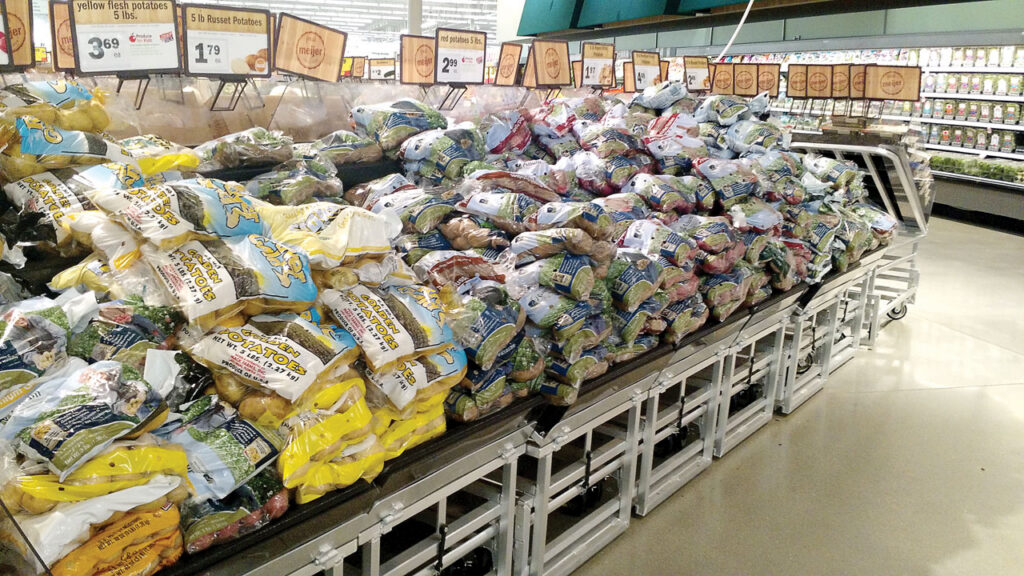
Retailers get a winning combination of quality, convenience to drive sales.
Wisconsin may be famous for cheese, but there’s another staple growing beneath the surface. Potatoes are big business in the Badger State, where ideal growing conditions, diverse varieties, and a long-standing commitment to sustainability give retailers plenty to dig into.
“Potatoes have become more important of a category in these last five years since the pandemic,” says Vince Mastromauro, director of produce operations for Sunset Foods, a five-store chain based in Highland Park, IL. “Russets are the top of the category, and we offer customers Wisconsin russets in 10-pound bags.”
WHY WISCONSIN
Wisconsin ranks third in the nation in potato production, behind Idaho and Washington, harvesting 2.8 to 2.9 billion pounds annually in 2025, according to the State of Wisconsin’s Department of Agriculture, Trade and Consumer Protection’s Wisconsin Agricultural Statistics, last updated May 11, 2026.
About two-thirds (63%) of the state’s potato yield goes to processing channels and just over one-third (37%) goes to the fresh table-stock market. The 2026 crop may see shifts between fresh and processed markets, with Wisconsin’s frozen potato production estimated to decline approximately 7%.
“Wisconsin has soil that is exceptionally good for potato production. It’s loose and sandy, drains water quickly, and allows roots to grow deep,” says Dana Rady, director of promotion, communication and consumer education for the Wisconsin Potato and Vegetable Growers Association (WPVGA), in Antigo, WI, a nonprofit organization that represents over 300 members and affiliates.
“Wisconsin has soil that is exceptionally good for potato production. It’s loose and sandy, drains water quickly, and allows roots to grow deep.”
— Dana Rady, Wisconsin Potato and Vegetable Growers Association, Antigo, WI
“Wisconsin’s climate is also ideal for growing potatoes,” says Rady. “The spring season is cool, the summers are warm, and the rainfall is plentiful. Cool summer nights also support a healthy potato crop. Wisconsin also sits atop massive, water-rich aquifers, so growers can irrigate when needed.”
Wisconsin has a logistical advantage as it’s located near the center of the nation. “This allows for a quicker response to order needs and delivery, resulting in fresher product for distribution to customers in the Midwest and East Coast,” says Christine Lindner, marketing manager at Alsum Farms & Produce, in Friesland, WI.
“[Wisconsin’s location] allows for a quicker response to order needs and delivery, resulting in fresher product for distribution to customers in the Midwest and East Coast.”
— Christine Lindner, Alsum Farms & Produce, Friesland, WI
Okray Family Farms Corp., in Plover, WI, has partnered with its customers, even in their own bags. “All of our Kwik locks have Wisconsin Potatoes printed on them,” says Brian Lee, transportation and sales manager. “So anywhere we ship east of the Mississippi, consumers know there are Wisconsin potatoes in the bag.”
SEASONAL FORECAST
As of mid-July, the Wisconsin potato crop was coming along nicely, says Lee. Early in the growing season, the state experienced rain, and the heat units were slow to appear. Once the heat units appeared, however, the rain became timelier, and the soil dried up quickly, causing some regions in the north to irrigate more frequently to ensure the crop was getting enough moisture. As a result, according to the WPVGA, the 2026 crop has been on time, with growers beginning early harvest at the end of July on reds, followed by yellows and then russets.
Last year, the Wisconsin crop was quite large due to high yields, says Rady, amid a challenging marketing year for all potato-producing states. “While Wisconsin saw good weather and high yields, so did other potato-producing states. This caused a surplus of supply, which created challenges at sales desks and led to many sales from the West occurring well below the cost of production.”
Rady says some western states are experiencing forest fires this year, as well as water-use limitations. “These factors, in addition to the weather Mother Nature has in store for the remaining weeks of the growing season and harvest, will all play a role in the quality and volume of the 2026 crop.”
A FULL CATEGORY
The state offers a year-round supply of russets, while yellows and reds finish up by January because of these varieties’ storability.
“Wisconsin is particularly good at growing russets, such as Burbank, Goldrush, Silverton and Norkotahs,” says Rady. The state also grows red varieties like Red Norland and Dark Red Norland and yellow/gold varieties like Yukon Gold, Oneida Gold, and Colomba, among others. And several Wisconsin farms supply The Little Potato Company in DeForest, WI, with petite-size potatoes.
“That said, there continue to be shifts between varieties planted and even between types. For example, some growers are reducing their red production while increasing the same amount in yellows.”
B-size yellow and red potatoes are most popular, says Mike Carter, chief executive of Bushmans’ Inc., in Rosholt, WI, “while there’s not as much demand for the larger reds and yellows.”
Organically grown potatoes are a small percentage of the overall market, however, it’s yet another level of variety Wisconsin provides consumers.
Alsum Farms & Produce, for example, offers 3- and 5-pound bags and 50-pound cartons of organic russet, yellow and red potatoes.\
“We have the capabilities to pack all of our potato varieties in packaging from 12 ounces up to 50-pound packs, and in poly, mesh, paper, or cartons,” says Lindner.
The company continues to automate its packaging facilities, with a major renovation project completed this summer. This project includes adding new palletizing robots and RPC/DRC filling solutions.
“Value-added is trending, with smaller pack sizes of B- and C-size potatoes, to four-pack trays, and individually wrapped potatoes that are 10- to 14-ounces each,” says Okray Family Farms’ Lee. “We currently have three lines to do trays and individually wrapped potatoes.
“Value-added is trending, with smaller pack sizes of B- and C-size potatoes, to four-pack trays, and individually wrapped potatoes that are 10- to 14-ounces each.”
— Brian Lee, Okray Family Farms Corp., Plover, WI
“Challenges are finding the right niche, right price point, and timing with any new equipment needed to produce. If you can make all these stars align, it can be good for packers, retailers and consumers.”
HOW TO SELL MORE
Consumers who want to know where their food comes from, how it’s grown, and have the freshest experience prefer local, says Lindner. “One positive example of a promotion is where grower/shippers partner with retailers to highlight locally grown produce programs.”
This partnership, Lindner adds, lets retailers tap into the local movement by connecting farmers and consumers through TV, radio, digital and social media, in-store sampling and sales promotions. Social media can spotlight freshness, growers, sustainability practices, potato varieties, nutrition and recipes.
The WPVGA offers retailers posters, brochures, nutrition information, recipe tear pads, and other point-of-purchase (POP) materials on request. The organization will again work with the agricultural ambassador program, Alice in Dairyland, as well as continuing to work with registered dietitians, run digital marketing campaigns and messaging in key urban areas, feature Wisconsin potatoes on an episode of WI Foodie, and continue to support the Wisconsin Healthy Grown Program.
The Wisconsin Spudmobile is also on the road to help educate consumers about Wisconsin potatoes and their significance in feeding families, says Rady. “Having the Spudmobile at various store locations is a valuable asset, as it allows visitors to see things from a grower’s perspective. They learn the field to fork story and get to have fun in the process.”
• • •
Retailers Spotlight Wisconsin’s Healthy Grown-Brand Potatoes
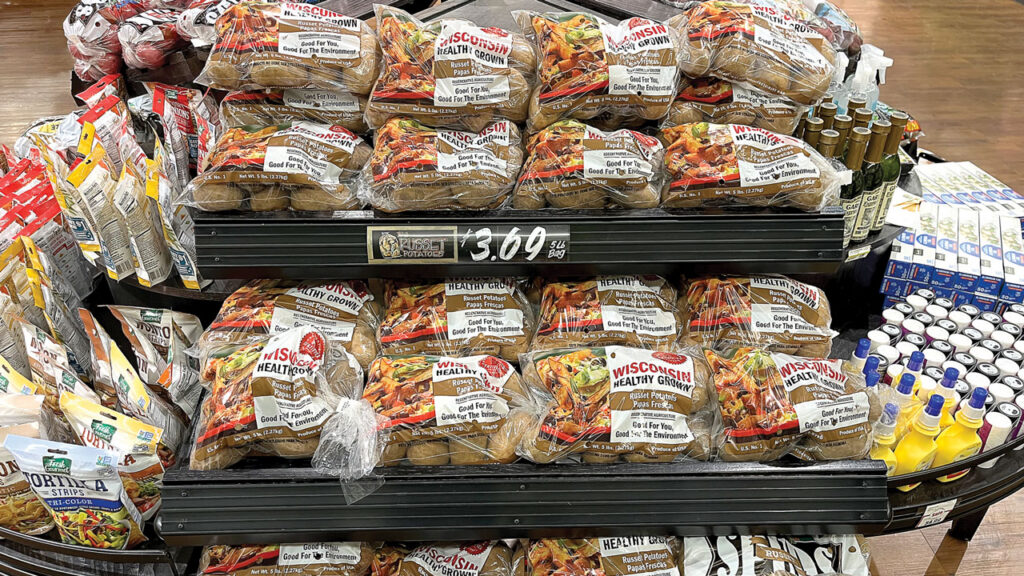
Walk into a Trig’s grocery store in Wisconsin’s Northwoods, and shoppers can find something different in the potato display: 5-pound bags of Wisconsin Healthy Grown-brand russet, red and yellow potatoes.
Earlier this year, Alsum Farms & Produce, in Friesland, WI, partnered with the four-store chain, operated by the T.A. Solberg Company headquartered in Minocqua, WI, on a two-week trial, which was the Wisconsin potato industry’s first retailer promotion of Healthy Grown-labeled potatoes since the program began in 1996.
The promotional opportunity went beyond stocking bags on shelves. Trig’s has since committed to carrying the potatoes from August 2026 through February 2027, while available.
“Local is preferred by consumers desiring to know how and where their food is grown and produced for the best, freshest eating experience,” says Christine Lindner, marketing manager at Alsum Farms & Produce. The company grows 2,700 acres of Wisconsin Healthy Grown Certified russet, red and yellow potatoes.
Wisconsin Healthy Grown traces its roots to the early 1990s, when the Wisconsin Potato and Vegetable Growers Association (WPVGA), based in Antigo, WI, and the University of Wisconsin-Madison began exploring ways to advance conservation and sustainability in potato production. Partnerships with conservation organizations followed, leading to the Healthy Grown brand in 2002. Today, growers use practices designed to protect water, manage pests, restore ecosystems, and support native plants and wildlife.
The WPVGA’s goal is to expand the brand’s retail presence, and is working with retailers to place Healthy Grown-labeled bags of potatoes in stores, “following the success with this effort early this year,” says Dana Rady, director of promotion, communication and consumer education.
The WPVGA also offers branded quarter-sized bins with information about Wisconsin’s Healthy Grown program, and Healthy Grown Kwik Lok tags to communicate the Healthy Grown product on the bag, without requiring retail stores to add another SKU.
The WPVGA, Rady adds, also encourages retailers to share Wisconsin growers’ sustainability efforts and multigenerational family-farm stories through in-store signage and online, while explaining the benefits of buying local.
13 of 19 article in Produce Business September 2026
Have a story to share?
Take a place at Produce Business