
Momentum in Michigan Apples
September 15, 2026 | 8 min to read
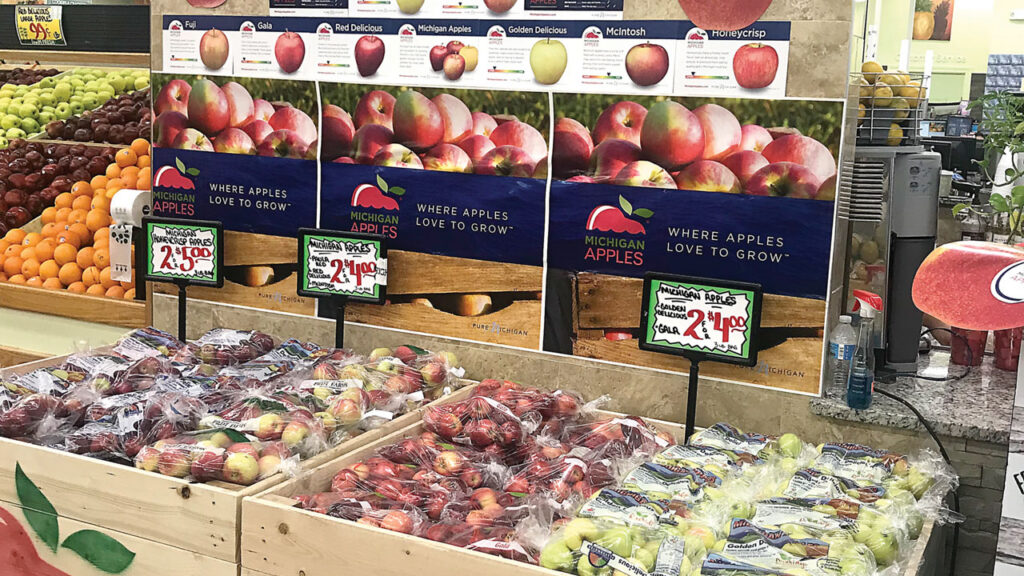
Stores can capitalize on the flavor, freshness and local appeal of Michigan apples.
Michigan is the second largest producer of apples in the United States, according to the Michigan Apple Committee (MAC) in Lansing, MI.
According to Diane Smith, executive director, in 2025, Michigan produced an estimated 30 million bushels of apples, and adds that with 17.6 million apple trees on 38,000 acres, apples are the largest and most valuable fruit crop in the state.
Michigan is critical to supply in the Midwest, South and Southwest, says Scott Morrison, general manager at Applewood Fresh Growers in Sparta, MI, providing regional fruit at competitive prices for most of the year. “Michigan apples can be found throughout the U.S., Canada and many other countries throughout the year.”
Michigan apples make up a majority of the apple program at Save A Lot, based in St. Ann, MO, with 650 stores. “Save A Lot promotes Michigan apples throughout the year as the season allows,” says Riley Hicks, produce category manager.
When Michigan apples are in season, they are the only apples handled at Hollywood Markets in Tory, MI, with three stores, according to Jeff Schultz, produce director.
“It is what our customers are looking for,” he says. “We will aggressively promote as soon as the new crop starts, all the way through February or March, and heavier in September and October with some variety in every ad.”
FLAVORFUL OPTIONS
Dedicated growers, ideal climate and nutrient-rich soil all contribute to the success of Michigan-grown apples.
“Our proximity to the Great Lakes allows for plenty of moisture and nutrient-rich soil,” says Smith. “Good weather conditions in each season enhance both color and flavor of the fruit.”
Partnerships with Michigan State University and other institutions also give Michigan growers access to research and innovative technology.
Flavor is one of Michigan’s greatest advantages, says Trish Taylor, marketing manager for Riveridge Produce Marketing in Sparta, MI. “The Great Lakes region typically provides the precipitation needed to grow quality fruit, followed by the warmth and sunlight that help develop the apples’ sugars and flavor,” she explains. “Michigan-grown Honeycrisp, in particular, consistently earns strong marks for its exceptional flavor, color and crunch.”
Michigan produces a variety of trending apples. “Honeycrisp, Gala, Fuji and Red Delicious are the most popular,” says Smith. “EverCrisp and Ambrosia aren’t necessarily new anymore, but continue to gain popularity.”
Honeycrisp remains the most popular variety at North Bay Produce in Traverse City, MI, which supplies customers year-round, says Ken Korson, apple category manager. “Two varieties continuing to gain popularity are Pink Lady and EverCrisp, both of which are harvested later in the season and have developed strong consumer followings.”
Shane Curtis, president of Jack Brown Produce in Sparta, MI, says Red Delicious and Fuji remain strong sellers, but there has been increased interest in Ambrosia, as well as Pink Lady.
At Jack Brown, which sells through Riveridge Produce, harvest begins in August, and Michigan apples are available well into the summer through controlled atmosphere storage.
Regional and unique varieties also have traction. “Consumers continue to shop regionally for local Michigan produce, including McIntosh and Jonagold,” says Applewood Fresh Growers’ Morrison. “We have seen an uptick in demand for club varieties, such as EverCrisp, SweeTango and Rave, which offer a high-flavor, premium eating experience.”
WIDE REACH
The Michigan apple region offers location advantages to regional and national retailers, adds Morrison.
“Due to our central location, Michigan produce can get to its final destination in a quick and efficient manner, maximizing shelf life and quality for the end consumer.” says Morrison.
North Bay’s Korson notes only about 20% of Michigan-grown apples remain within the state. “Most of our apples are marketed throughout the Midwest, but we also export to destinations throughout South and Central America and as far away as India,” he says. “We streamline distribution by offering major apple varieties 12 months a year, which reduces the need for retailers to source from other growing regions.”
Retailers increasingly want fruit grown as close to their stores and customers as possible, explains Taylor. “This benefits freshness, freight efficiency and local storytelling.” Riveridge apples are distributed throughout the Midwest, along the East Coast, south to Texas and Florida, and into international markets.
Quality is a crucial element of the supply chain. “Every apple that FirstFruits and Applewood ship out has the end consumer in mind,” says Morrison. “We check quality at every step of the process to ensure an eating experience that will bring the customer back to shop for apples again.”
DELIGHTING SHOPPERS
The best way to create in-store excitement with Michigan apples? “Build large, attention-grabbing displays, place them in high-traffic areas, and maintain them throughout the day so they always look fresh, full, and inviting to shoppers,” says Korson. “The biggest factor is location, location, location. Displays positioned at the front of the produce department generate the most impact.”
“Build large, attention-grabbing displays, place them in high-traffic areas, and maintain them throughout the day so they always look fresh, full, and inviting to shoppers. The biggest factor is location, location, location. Displays positioned at the front of the produce department generate the most impact.”
— Ken Korson, North Bay Produce, Traverse City, MI
Save A Lot’s Hicks recommends full, fresh displays with minimal gaps, as well as signage that highlights the variety and a few key characteristics.
“Also, cross-merchandise with items, such as caramel dip, peanut butter and pie crusts,” he says.
The most effective displays must be fresh, eye-catching, and have great tie-ins, agrees Schultz of Hollywood Markets. “Price point is important, but not the most important,” he says. “Fresh quality and flavorful produce will always be most important.”
Offer a mix of familiar favorites and discovery varieties, suggests Taylor. “Honeycrisp attracts attention, while varieties such as EverCrisp and Ambrosia give shoppers something new to try.”
Applewood Fresh’s Morrison says the most impactful way to increase apple sales remains simple: Let shoppers taste the product.
“Sampling consistently delivers results because it removes uncertainty from the purchase decision,” he says. “When shoppers get the eating experience in-store, they are significantly more likely to purchase immediately and return for repeat purchases. We’ve also implemented this for online and e-commerce shoppers, offering single SweeTango apple sample boxes free with certain purchases.”
SALES SUPPORT
A variety of promotional support comes through growers. For example, North Bay Produce offers promotional pricing programs, ad support, and hot-buy opportunities to help retailers maximize sales throughout the season, says Korson.
Riveridge works with retailers to customize promotions, develop content and bring new merchandising ideas to life. “Whether through in-store displays, digital campaigns, grower stories or seasonal promotions, the goal is to put more apples in shopping carts and encourage consumers to enjoy them at home and on the go,” says Taylor.
Hollywood Markets receives most of its support through its supplier SpartanNash or directly from growers, according to Shultz.
“Mostly we use Belle Harvest, Riveridge and North Bay,” he says. “The bins of handle bag Honeycrisp have become very popular. Super easy for the customer to grab a bag and go. It’s a great ring for the retailer as well, being an average of five pounds per handle bag. We bring in multiple bins and display them across the outside front of the store.”
Managed variety organizations also offer resources. “Applewood grows and sells several managed varieties that have become a significant growth driver within the apple category,” says Morrison.
“Varieties such as EverCrisp, SweeTango and Rave have benefited from coordinated marketing support and strong retail promotion. Those investments, passed along to retailers, help generate trial. An omnichannel marketing approach with demo sampling, POS (point-of-sale) support, recipe content, and social media influence all support increasing sales at retail.”
MAC focuses its efforts on increasing consumer demand for Michigan-grown apples through consumer marketing and education.
“Our target audience is very active on social media, therefore, we have built a robust online presence to engage with that audience,” says Smith. “We educate consumers on numerous specific health benefits of eating apples through our registered dietitians who create content for our Healthy Living section of the website, as well as social media content, and we also participate in events and partnerships supporting our online messaging.”
LOCAL APPEAL
Michigan apples are bolstered by demand for local and regional produce. “The local movement always gives us an early-season boost and helps drive sales,” says Korson. “Consumers enjoy supporting local growers, and Michigan apples benefit from that strong local connection.”
The local movement has a positive impact on sales and marketing for Michigan apples, agrees Hicks of Save A Lot. “Once the new crop starts, we see a stronger demand for apples by featuring local varieties with displays and signage,” he says.
MAC’s consumer research indicates consumers want to know where their apples come from. “They are seeking sustainable and environmentally friendly choices, and looking for great flavor,” says Smith.
“Fall is our biggest time of year for consumer activity because apple season is simply part of the culture in Michigan.”
— Diane Smith, Michigan Apple Committee, Lansing, MI
“Michiganders get excited about apple harvest each year, and flock to Michigan’s farm markets, orchards and cider mills. They also seek out Michigan-grown apples in their grocery stores.”
Retailers have been great partners in the local and regional promotion of growers and their produce, says Morrison. “Shoppers increasingly want food transparency, making Meet the Grower content a successful retail integrated marketing approach for us. Sharing photos, videos and stories from the orchard helps consumers understand where their food comes from and creates an emotional connection with the product.”
Consumers want to buy local when they can, agrees Curtis of Jack Brown. “Using Michigan-grown messaging in marketing and on packaging helps shoppers quickly identify local apples.”
14 of 19 article in Produce Business September 2026
Have a story to share?
Take a place at Produce Business