
Trends in Produce Displays, Misting & Fixtures
August 11, 2026 | 9 min to read
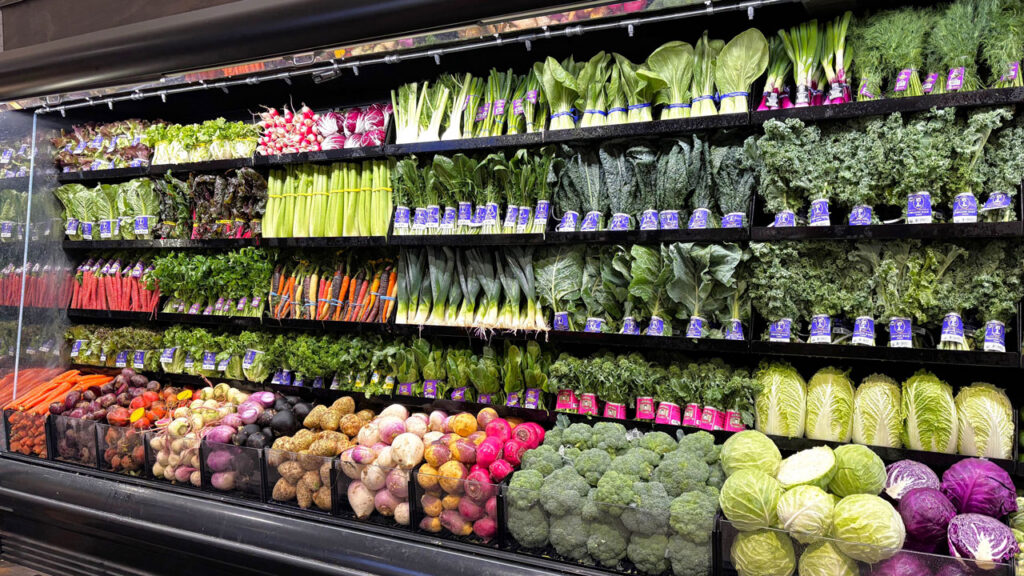
Retailers are investing in produce misting systems and displays to create a visual impact.
Shoppers walking into one of the two Common Market Co-Op stores in Frederick, MD, are met first by produce, where wet racks overflowing with leafy greens and brightly colored vegetables create an immediate impression of freshness.
That first visual matters. Ninety-five percent of consumers say produce quality influences where they shop for groceries, according to FMI — The Food Industry Association’s The Power of Produce 2025 report, reinforcing produce’s role as a key driver of store choice.
“The wet rack is like one big opportunity to do a giant display in the center of your department, and you can change it every day,” says Mike Leveille, produce manager, Common Market Co-Op. “Wet racks can be reset, rearranged, and refreshed to reflect seasonality, local sourcing, or simply create a more abundant appearance.”
Yet maintaining that look requires constant cleaning, watering, culling, and employee know-how, adds Leveille, “Our staff pulls the entire wet case every single night and resets it every morning. The goal is straightforward: Keep everything as fresh-looking as possible and as full as possible.”
The buy-with-your-eyes appeal shoppers see in fresh fruits and vegetables on wet racks, as well as refrigerated display shelves and dry tables, depends on behind-the-scenes technology and fixtures designed to maintain freshness, presentation and performance.
“Produce remains one of the most important departments for creating a fresh impression. Still, retailers are under pressure to make displays look abundant without overstocking product.”
— Robb Northrup, Siffron, Twinsburg, OH
“Today’s leading produce display trends are being driven by three priorities: stronger visual presentation, easier store execution, and better shrink control,” says Robb Northrup, director of marketing and communications at Siffron, a Twinsburg, OH-headquartered global manufacturer of retail display fixtures. “Produce remains one of the most important departments for creating a fresh impression. Still, retailers are under pressure to make displays look abundant without overstocking product.”
WET RACK MAGIC: SHELVES & BINS
Refrigerated displays account for an estimated 60% to 65% of produce sales, while dry-rack displays generate the remaining 35% to 40%, according to industry estimates cited by the International Fresh Produce Association, headquartered in Washington, D.C. Space-wise, the wet rack accounts for roughly 20% to 35% of the department’s refrigerated space.
“While the wet rack may not have the same sales/volume of other categories in produce, we feel it is extremely important to the overall performance of the department,” says Dustin Duerr, director of produce and floral for Coborn’s, Inc., a St. Cloud, MN-based grocery retailer with 79 stores across five Midwest states, under the Coborn’s, Cash Wise Foods, Marketplace Foods, Hornbacher’s, Kessler’s Food and Grocery and Sullivan’s Foods banners.
“This spring, we met with all our produce managers to discuss key initiatives for the rest of the year. One part of our meetings was solely dedicated to the importance of this section. The performance and appearance of the wet rack can quickly sway guests’ perceptions of quality and freshness throughout our entire produce department. We trained on the proper setup of the wet rack, proper handling of specific items, and showed examples of great and poor-looking sections to emphasize the importance,” he says.
Coburn’s recently partnered with Carlson AirFlo, a Brooklyn Park, MN-based company that specializes in innovative, durable merchandising systems for the retail grocery and floral industries, and used the company’s AirShelf merchandising system at its new Coborn’s Market & Table store in Plymouth, MN. The AirShelf is a specialized, low-profile commercial shelving system designed to optimize product visibility, increase merchandising space by 10-25% per 4-foot section, and improve airflow at retail.
“This system really checked the boxes we were interested in and looking to achieve with merchandising in our wet sections,” says Duerr. “The system allows the product to be the focus of the case, not the shelves. It offers significant flexibility in merchandising compared to conventional shelving. The shelves are LED, and sections can be customized with 1- and 2-foot shelves to accommodate the dimensions of different produce items. We also utilized the shelving’s ability to install product stops, which allowed us to merchandise the appearance of a full shelf while preventing overfilling.”
Last year, Carlson AirFlo introduced its AirBin, a fully integrated bin system that fits directly into existing refrigerated cases, installing a standard 4‑foot section in under four minutes with no loose parts, tools, or assembly required. The bin is constructed from anodized aluminum, which won’t rust, chip, peel, or flake, even in wet, high‑moisture produce environments.
“With average produce department shrink typically ranging from 4% to 8% of department sales, AirBin helps retailers reduce shrink by significant percentage points by preventing over‑loading through right‑sized bin selection, improving airflow with a 33%-hole pattern to maintain freshness, and reducing stacking pressure and handling damage,” says Sharon Johnson, director of sales and marketing. “These improvements help protect margins while ensuring fresher product for consumers.”
MULTI-USE MISTING SYSTEMS
Misting products in the wet rack, such as lettuces, greens like kales, collards, chards, spinach, etc., broccoli, various herbs, cabbages, roots, scallions, and leeks, is an absolute must to keep them fresh, according to Brian Dey, retail and merchandising innovation manager for Four Seasons Produce, in Ephrata, PA. “There are many ways to keep product misted and fresh. Several companies offer misting system designs that automatically mist product on a timed cycle. This is the most popular way most stores use, and you do not need to keep hand misting or remembering to do so.”
Other ways of keeping the product fresh include hoses with waterlines into the case and air-pressure hand-pump sprayers, but both require manual spraying, Dey adds. “However, they help control how much water is applied to the product. Sometimes, excess water can waterlog produce and accelerate decay, especially when wet racks and shelving lack proper drainage. This is where the purchase of the right equipment is essential.”
Increasingly, retailers are reducing clutter, focusing on top-selling items, and moving some items to either dry tables or pre-packaged, according to Emily Stavrou, vice president of the Gurnee, IL-headquartered Corrigan Corporation, a manufacturer of automated produce misting systems for supermarkets. “Unfortunately, wet walls are losing some space to convenience-driven SKUs. Also, some retailers are moving items typically found in a wet wall behind closed doors. Retailers need to know that this produce, for example, mushrooms and garlic, still needs to be humidified to counteract the drying effects of refrigeration.”
Introduced by the company in 2023, Préserve is a non-wetting, 5-micron nebulization system designed to create an optimal wet rack environment that helps protect perishables. Its integrated TriOBreeze activated-oxygen technology automatically sanitizes produce cases, reduces harmful pathogens, and has been proven to extend the shelf life of fruits and vegetables.
The dry fog system can be installed above virtually any product and across multiple case formats, offering merchandising flexibility from wet racks to island displays, helping maintain freshness in apples, potatoes, and other dry table items.
MOBILE MERCHANDISERS
On-floor refrigerated merchandising is gaining traction, allowing retailers to spotlight products rather than have them disappear within large multi-deck wall cases, says Chris Schotsman, vice president of sales and marketing for Cayuga Displays, in Cayuga, Ontario. “On-floor refrigeration helps preserve certain products, gives them a bit more shelf life, with less shrink, and a higher quality perception.”
The company’s Fresh Go bin, introduced in 2022, is a mobile 3×3-foot refrigerated merchandiser that can maintain critical temperatures of 38-41 F, ideal for fresh-cut
fruit. The unit also serves as an effective sales tool for seasonal or targeted promotions.
Retailers are increasingly requesting that on-floor refrigerated displays match dry displays, Schotsman adds. “Customers like our integrated designs, flexibility, adaptability, modularity, options in finish, etc. It gives them the chance to create a unique look and feel that speaks to their brand: not ‘me-too.’”
MODULARITY ON-DEMAND
Retailer demand is moving strongly toward modularity, especially in fresh departments where assortment, seasonality, and promotional needs change frequently, according to Siffron’s Northrup. “Modular displays allow retailers to adjust shelf angles, product spacing, packout, and presentation by category or season. They also help stores test new layouts without committing to a full fixture replacement.”
One of the biggest drivers behind this shift is the need for right‑sized merchandising.
“Many retailers want smaller produce displays, not oversized ‘pile it high’ merchandising,” says Sebastian Nagy, senior sales representative for LemonTree Products, an Erin, Ontario-based manufacturer specializing in modular, customizable grocery store produce displays. “In the past, displays were 72 to 80 inches with large mountains of produce. Now, lower basket size, reduced buying volume, and the need to control shrink are driving smaller displays.”
“Many retailers want smaller produce displays, not oversized ‘pile it high’ merchandising. In the past, displays were 72 to 80 inches with large mountains of produce. Now, lower basket size, reduced buying volume, and the need to control shrink are driving smaller displays.”
— Sebastian Nagy, LemonTree Products, Erin, Ontario
Fixed units still have a place, particularly when a retailer wants a consistent brand look, high durability, or a permanent destination statement, says Siffron’s Northrup.
“However, fixed units can limit flexibility when product mix, packaging, or merchandising strategy changes. That’s why the best approach is often a hybrid: durable core structures paired with adjustable, removable, or reconfigurable merchandising components. This allows retailers to maximize selling space while still adapting to seasonal volume, changing package sizes, and labor realities.”
PUTTING PRODUCE FIRST
Whether wet or dry, refrigerated or non-refrigerated, or fixed, mobile, or modular, today’s produce fixtures are being designed to put the focus on the product rather than the display itself, according to Mark Chenoweth, vice president of sales for Alco Designs, in Gardena, CA, which specializes in designing custom merchandising displays and fixtures for the grocery retail industry.
“Consumers want to see produce, not the merchandising equipment. Merchandising equipment must become invisible to the consumer. With the price of produce items seeing inflation over the past five years, it’s more important than ever to make the produce items the star of the show.”
“Consumers want to see produce, not the merchandising equipment. Merchandising equipment must become invisible to the consumer. With the price of produce items seeing inflation over the past five years, it’s more important than ever to make the produce items the star of the show.”
— Mark Chenoweth, Alco Designs, Gardena, CA
A good example is the company’s VersaWall, introduced in 2022, which turns underutilized vertical space above refrigerated cases into high-impact merchandising. Tilted trays, floating shelves, and nearly invisible hardware put produce, not fixtures, front and center, creating a clean, abundant wall of fruits and vegetables that emphasizes color, freshness, and organization.
LOOKING AHEAD
On the horizon for produce departments and merchandising, the near term is all about continuous improvement in areas such as shrink control, lower labor, right-size merchandising, sanitation, and improved presentation, says Chenoweth. “Within the next five years, technology will be incorporated into produce departments, allowing the tracking of inventories, analyzing consumer engagement, and shopping trends. These things are in early development as we speak. You never know, you may see a robot helping merchandise produce items in your store soon.”
1 of 17 article in Produce Business June 2026
Have a story to share?
Take a place at Produce Business