
The Latest in Consumer-Facing Corrugated Packaging
July 20, 2026 | 10 min to read
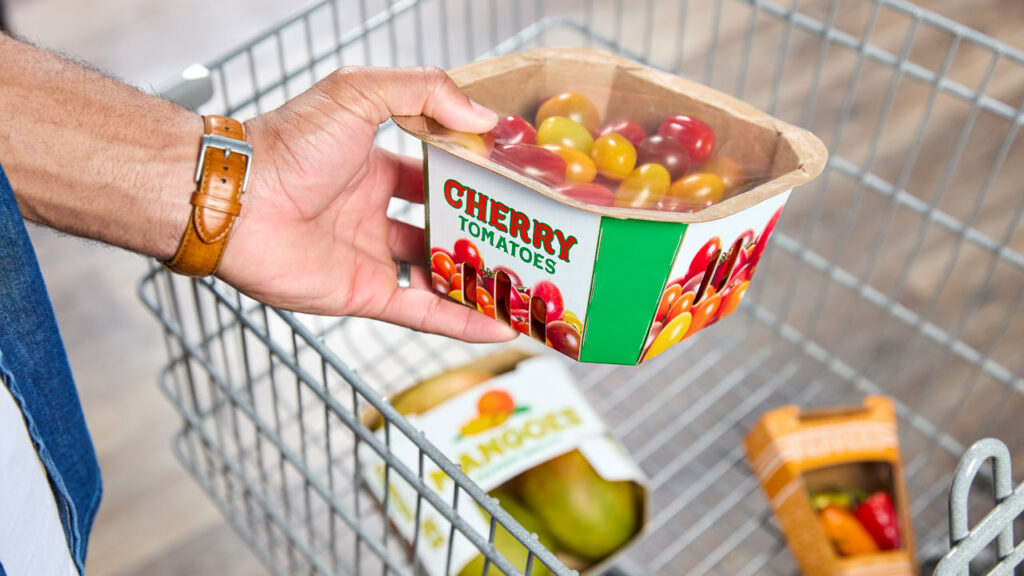
From box to brand builder, corrugated moves to the spotlight.
Corrugated packaging is no longer confined to shipping boxes stacked in the backroom. Today, it and other paper-based packaging are moving front and center, onto retail shelves, into shoppers’ hands, and into the strategic plans of growers, shippers, and retailers seeking to balance sustainability, performance and cost.
That shift reflects a broader change in the produce industry, where packaging is expected to do more than protect the product. It must also protect quality, support merchandising, and meet rising environmental expectations. Demand is following suit, with the fresh produce packaging market projected to grow 2.4% annually to $7.3 billion by 2028, driven by increased use of retail-ready, value-added formats rather than higher production volumes, according to the U.S. Fresh Produce Packaging Market 2024-2033 report, by ResearchAndMarkets.com, headquartered in Dublin, Ireland, with U.S. offices in New York, NY.
KEY DRIVERS
Several converging trends are accelerating corrugated’s role in produce packaging. Sustainability is one of the strongest drivers of innovation in consumer-facing corrugated produce packaging.
“Sustainability is one of the core values of New Leaf Community Markets, so we are always looking for ways to reduce unnecessary packaging,” says Maroka Kawamura, senior category manager for produce of New Leaf and Lazy Acres Natural Market, both owned by Good Food Holdings, Inc., in Carson, CA. “We don’t require vendors to use only compostable or cardboard packaging, as that can increase costs for many of the smaller growers we work with. That said, we encourage sustainability efforts across the industry.”
Growers, retailers, and brands are actively looking to reduce plastic use while maintaining performance and shelf life.
“An advantage of corrugated material is its infrastructure readiness: curbside acceptance and high recovery rates allow for circularity, while reusable plastic containers (RPCs) depend on controlled, closed-loop systems for transport, return, washing, and redistribution,” says Brian Pincus, vice president of innovation for Smurfit Westrock, in Atlanta, GA.
Over two-thirds (69%) to nearly three-fourths (74%) of cardboard available for recovery was recycles in the U.S. in 2024, making corrugated one of the most recycles packaging materials, according to the American Forest & Paper Association, 69% to 74% of cardboard available for recovery was recycled in the U.S. in 2024, making corrugated one of the most recycled packaging materials.
In the U.S., the new Extended Producer Responsibility (EPR) laws are driving companies to this type of packaging, according to Steve Greenfield, director of sales and marketing of NNZ Inc., North America, headquartered in Suwanee, GA. “Even though paper, paperboard, and corrugated are more environmentally friendly, some of the EPR laws still charge for this material, just not as much as plastic. But companies are looking for ways that this material can replace single-use plastics.”
EPR laws are state-level policies that hold manufacturers responsible for the entire lifecycle of their packaging and products. This shifts disposal costs from municipalities to producers. These laws require companies to join producer responsibility organizations (PROs), pay fees based on packaging material, and meet recyclability targets, according to the Sustainable Packaging Coalition, in Charlottesville, VA. Currently, seven states have passed EPR packaging bills: Maine, Maryland, Minnesota, Colorado, California, Oregon and Washington. Five states, New Hampshire, Rhode Island, Georgia, Missouri and Wisconsin, have introduced legislation on EPR for packaging in 2026.
Beyond sustainability, “today’s demand for corrugated packaging in fruits and vegetables is driven by sustainability, eCommerce and retail-ready convenience, as well as the need for better freshness control,” says Lauren Campen, senior manager, public affairs and communications for corrugated at Georgia-Pacific, in Atlanta, GA, pointing to innovations such as ventilated designs, moisture management features and protective cushioning.
At the same time, consumer habits are reshaping packaging needs.
“The rise in demand for snackable fruit and vegetable options is driving use occasions for grab-and-go convenience,” adds Smurfit Westrock Pincus. “Corrugated trays enable on-shelf merchandising and can capture point-of-sale attention all in one pack.”
Corrugated’s evolution is also being fueled by competition and innovation across the packaging landscape.
“Corrugated packaging continues to evolve in response to growing demand and increasing competition across the fresh produce market,” says Ashley Rixey, director of communications for the Fibre Box Association, in Itasca, IL. “The industry is innovating on multiple fronts, strengthening corrugated’s position through advances in both functionality and sustainability.”
WHAT’S NEW
New product development in paper-based packaging is rapidly transitioning from concept to commercial reality, with designs that not only meet sustainability goals but offer advances that translate into highly functional, shopper-ready formats at retail.
“A lot of our fall seasonal favorites like cherry tomatoes and peppers come in cardboard open pints,” says New Leaf Community Markets’ Kawamura.
New corrugated produce packaging now features improved ventilation via vent slots and flute selection, retail-ready designs that ship as in-store displays, and recyclable mono-material or low-film coatings that balance moisture protection with recyclability, according to Georgia-Pacific’s Campen. Examples include perforated retail‑ready corrugated trays that reduce store labor and corrugated sleeves that replace PET clamshells for better end‑of‑life performance.
“These enhancements can increase per‑unit material or conversion costs, especially for specialty fibers, coatings, or low‑volume tooling, but often deliver supply‑chain savings via less secondary packaging, lower transport and stocking labor, and avoided disposal fees that offset the premium,” Campen adds. “As a result, corrugated is often slightly more expensive than some plastics on a pure per‑package basis but is frequently cost‑competitive or cheaper when total landed cost and sustainability benefits are included.”
Paperboard is carving out its own niche, particularly in lighter-weight, high-visibility applications where cost and merchandising matter. The use of one or the other is based on the weight of the package and the better protection the corrugated provides for the product. But paperboard has its advantages as well, primarily lower costs.
“One of the new ways that I’m seeing paperboard or possibly micro flute corrugated is in the recent trend of a 4-pack of organic apples, for instance. I believe Stemilt was the trailblazer for this packaging, using a banded wing tray. The downside of this package is that it requires a banding machine that ranges from $60,000 for a manual version to $300,000 for an automated version,” says NNZ’s Greenfield.
Newer designs are also lowering barriers to adoption while protecting product integrity. NNZ has been licensed to sell the Pop-Up Pack, which is like the banded tray but requires no machinery to start.
“It comes flat, and when pushed down into a jig or a box, it pops into its form, where a self-adhesive label can then be applied once the product is put in,” says Greenfield. “This can then be semi-automated for about $40,000 using wing-folding rails on a conveyor belt and a wipe-on labeler. As the project scales, it can be fully automated, and the wings can be glued down. Because the Pop-Up Pack comes flat, you can ship more in less space, it takes up much less space in an inventory area, and in so doing, saves on the carbon footprint as far as the transport.”
Snack-sized innovation is expanding the category beyond the produce department while maintaining quality in smaller formats. NNZ’s “Snack Fresh,” a small paperboard snack-sized box for blueberries, grape tomatoes, or grapes, comes with a retail-ready display carton that doubles as its shipping carton. The uniqueness of this product is that it is meant to be displayed at the checkout counter, not in the produce section.
Meanwhile, another of the company’s new paperboard products is the Q-Bic, a truncated pyramid-shaped tray or clamshell that saves 30% on shipping costs because of its packing. It also lowers the carbon footprint.
“It is best used for blueberries and grape tomatoes or anything with small voids,” says Greenfield. “Where you normally pack 12, let’s say pint units, in a transport carton, you can now put 36 units or pints in the same carton.”
Some of these new formats are integrating next-generation coatings that enhance performance by controlling moisture and/or providing oil barrier properties. However, some coatings negate the packaging’s recyclability.
“There are now some food-based coatings that do not negate the recyclability and are FDA food-safe contact,” says NNZ’s Greenfield. “One example is a Michigan-based company called PakitGreen. This coating maintains its beneficial characteristics while still allowing the product being coated to enter the recycling stream. Some paperboard companies have added ethylene absorption coatings to give longer shelf life right in the package.”
SELL READY SOLUTIONS
Beyond sustainability, retail-ready convenience, better freshness control, and catering to consumer eating habits like grab-and-go snacking, packaging today plays a big role in helping to sell what’s inside.
“Today’s corrugated produce packaging is more than just a shipping container; it’s a consumer‑facing, retail‑ready solution that offers merchandising benefits beyond reusable plastic systems,” says Smurfit Westrock’s Pincus. “Advances in digital and flexographic printing are also enabling more seasonal and promotional graphics on corrugated displays and cases.”
“Today’s corrugated produce packaging is more than just a shipping container; it’s a consumer‑facing, retail‑ready solution that offers merchandising benefits beyond reusable plastic systems.”
— Brian Pincus, Smurfit Westrock, Atlanta, GA
A great example is the new 4-kg Lidded Mango Carton, made from corrugated board, introduced by Mission Produce in Oxnard, CA, in February.
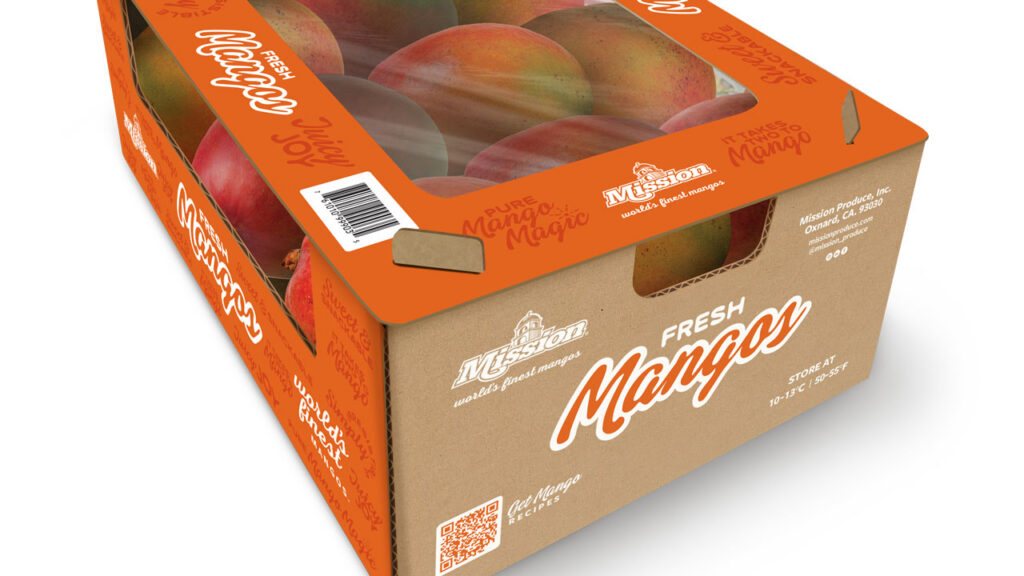
“Corrugate also provides an excellent surface for printing, which allows us to incorporate strong branding and clear product communication,” says Brooke Becker, senior vice president of sales. “For the lid, we used coated paper to achieve sharper graphics and added a clear polyester film window so shoppers can see the beautiful mangos inside. This combination allows the packaging to both protect the fruit and help it merchandise effectively at retail.”
Beyond consumer packaging, corrugated display shippers continue to evolve their design for fresh produce with an emphasis on: product protection, retailer-specific packaging, short production runs, and brand storytelling, says Georgia-Pacific’s Campen, adding that the company continues to see demand in this space by brands and retailers who are looking for photo quality produce imagery, localized graphics, and short seasonal runs.
“The biggest innovation we’re embracing is the evolution of corrugated into a true marketing medium,” says Diana Salsa, vice president of marketing for Wonderful Pistachios, owned by the Wonderful Company, in Los Angeles, CA. “These shippers function as in-store billboards that communicate brand messaging, nutritional benefits, and usage occasions directly at the point of purchase.”
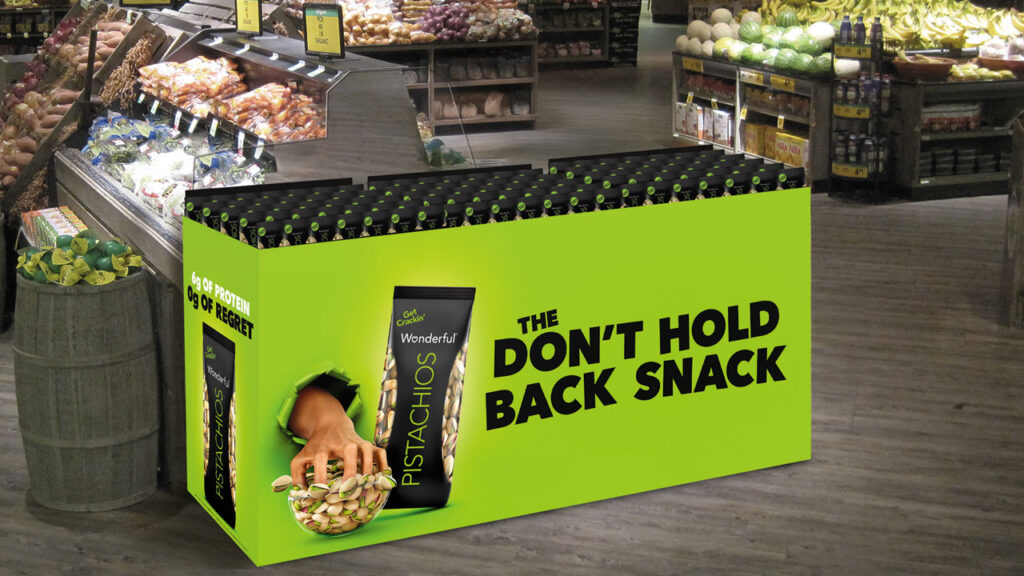
“The biggest innovation we’re embracing is the evolution of corrugated into a true marketing medium. These shippers function as in-store billboards that communicate brand messaging, nutritional benefits, and usage occasions directly at the point of purchase.”
— Diana Salsa, Wonderful Pistachios, Los Angeles, CA
Wonderful Citrus offers retailer’s hexagon-shaped corrugated bins with culinary-themed header cards for its Wonderful Seedless Lemons.
“These bins are ideal for the produce department or secondary placements, such as seafood, helping to inspire cross-merchandising opportunities. Stores featuring the hexagon bins with culinary-themed headers have seen +24% velocity lifts versus stores without point-of-sale, demonstrating how innovative corrugated displays not only elevate brand presence but also drive incremental sales,” says Zak Laffite, president of Wonderful Citrus.
Corrugated shippers are ideal at retail for spot buys, seasonal promotions, and secondary displays, says Jay Schneider, produce sales manager for Acme and Safeway banners, part of the Albertsons Companies Mid-Atlantic Division, headquartered in Malvern, PA, and encompassing nearly 300 stores across eight states and the District of Columbia. “They double as instant display units. We pop them up throughout the department and in high traffic areas.”
Display-ready corrugated continues to grow, reducing labor and improving setup at retail, says Noah Fox, project manager for Fox Solutions, LLC, in McAllen, TX, which manufactures specialized flexible packaging for the fresh produce industry. “From our perspective, success comes down to consistency. Clean pack out, proper bag fit, and ease of handling are what make these programs work operationally.”
LOOKING AHEAD
Future trends in corrugated shippers could include moving to a more connected and smarter shipper that delivers better traceability and increases customer experience through unique marketing interactions via QR codes, Variable Date, NFT links, etc., according to Georgia-Pacific’s Campen.
Looking ahead, corrugated produce packaging’s biggest challenges will be meeting tightening sustainability and regulatory demands such as EPR and recycled-content mandates, ensuring true recyclability despite food contamination and necessary barrier coatings, competing on cost and performance with low‑price plastics, and managing raw‑material volatility plus upfront tooling and conversion investment for low volumes, all while preserving produce respiration, shelf life, and damage protection, Campen adds.
“Major opportunities include new mono‑material/aqueous coatings and flute engineering that balances breathability with recyclability, retail‑ready designs that cut store labor and secondary packaging, digital printing and short‑run customization for promotional flexibility, and automation of converting/filling to drive down per‑unit costs,” says Campen. “By pairing lifecycle LCA data and total‑landed‑cost models with retailer partnerships and closed‑loop recycling initiatives, corrugated solutions can capture sustainability premiums, accelerate plastic‑to‑paper conversions, and unlock long‑term cost and brand advantages.”
Have a story to share?
Take a place at Produce Business