
Most ERP Systems Don’t Have a Produce Planning Problem. They Have an MRP Problem.
September 16, 2026 | 9 min to read


Every produce business has a moment when the plan stops being the plan.
Sometimes it happens before the first truck arrives.
A grower calls.
Yields are lower than expected.
A retailer increases an order.
A customer changes specifications.
A shipment is delayed.
By nine o’clock, decisions that looked right an hour earlier are already being questioned.
That isn’t poor planning.
It’s simply the reality of fresh produce.
Yet many ERP systems continue to treat planning as though nothing has changed.
And that’s where the real problem begins.
The Produce Industry Doesn’t Need More Planning. It Needs Better MRP.
Material Requirements Planning has become one of the most widely promoted capabilities in ERP.
Today, almost every software provider claims to offer it.
Planning screens.
Purchase recommendations.
Production schedules.
Demand forecasts.
On paper, the functionality often looks remarkably similar.
But produce businesses should ask a very different question.
When the unexpected happens, can your MRP confidently run your operation—or does it simply tell you what changed?
There is a significant difference.
One reports.
The other responds.
Produce Was Never Meant to Fit a Manufacturing Formula.
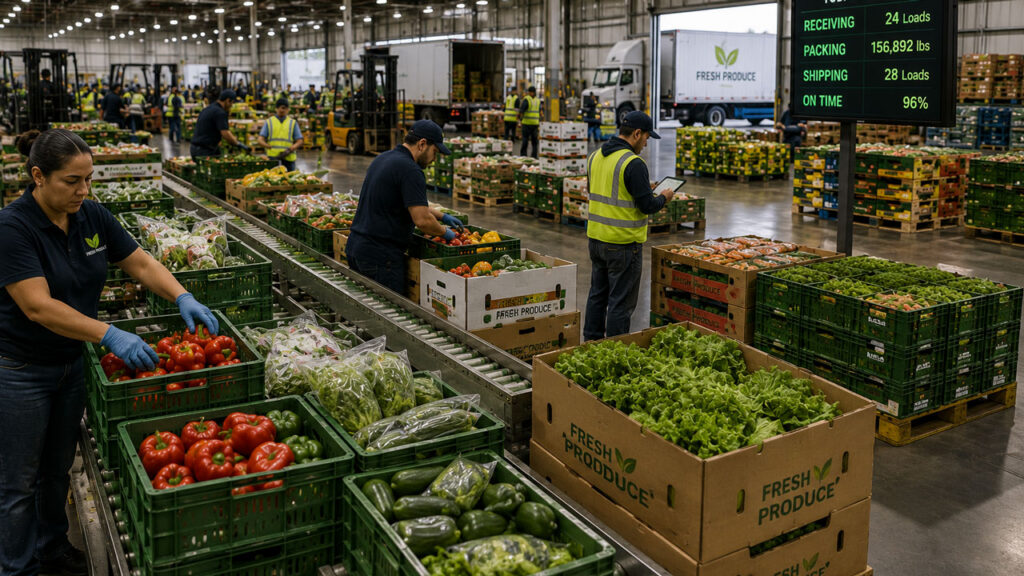
Traditional MRP was built around predictability.
Raw materials arrive.
Production follows a schedule.
Finished goods are produced.
Fresh produce ignores those rules.
Supply changes daily.
Yields fluctuate.
Quality varies.
Shelf life continues to decline.
Customer priorities change.
Packing plans move.
Transport schedules shift.
Every decision creates another.
Planning isn’t a process that starts each morning.
It’s a process that never stops.
Which means MRP shouldn’t simply calculate requirements.
It should continuously recalculate reality.
Every Planner Already Knows the Hardest Part of Their Job.
It isn’t creating the plan.
It’s knowing whether they can trust it.
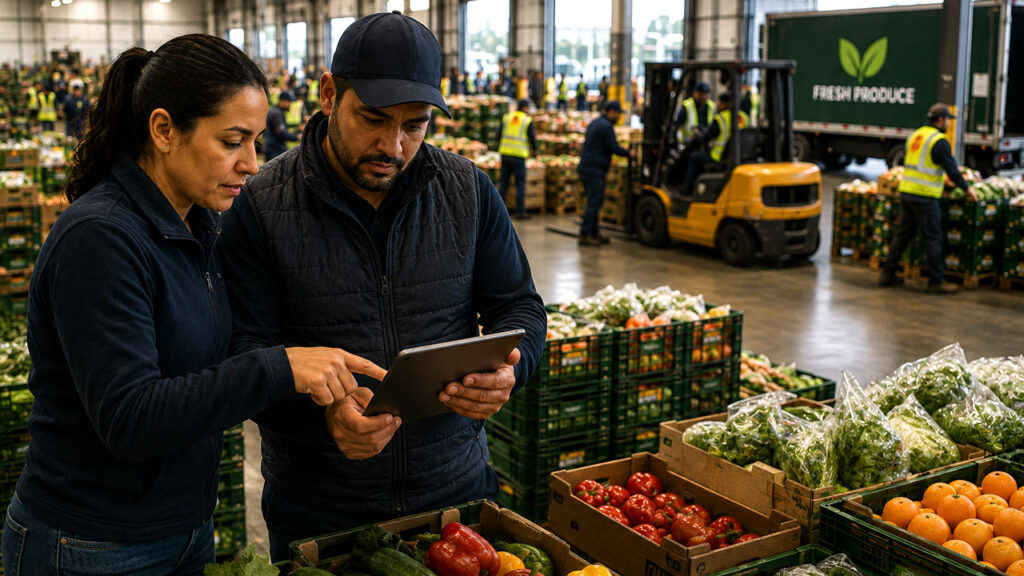
Walk through almost any produce operation and you’ll hear the same conversations.
- “Can someone confirm inventory?”
- “Has purchasing committed enough product?”
- “Can production still make today’s schedule?”
- “Will this affect tomorrow’s shipments?”
- “Who changed that allocation?”
Those conversations aren’t the problem.
They’re the symptom.
They reveal something every produce executive already understands.
Planning slows down whenever information falls behind reality.
And in produce, reality changes by the minute.
This Is What True Produce MRP Should Do.
True Produce MRP shouldn’t simply tell you what to buy.
It should determine exactly what is required, when it is required, and continuously rebalance the operation as conditions change.
It should understand demand before shortages occur.
It should recognize changing yields before production is affected.
It should optimize available inventory before unnecessary purchasing takes place.
It should balance customer commitments before promises become problems.
It should help planners make better decisions—not ask them to spend their day gathering information before they can make one.
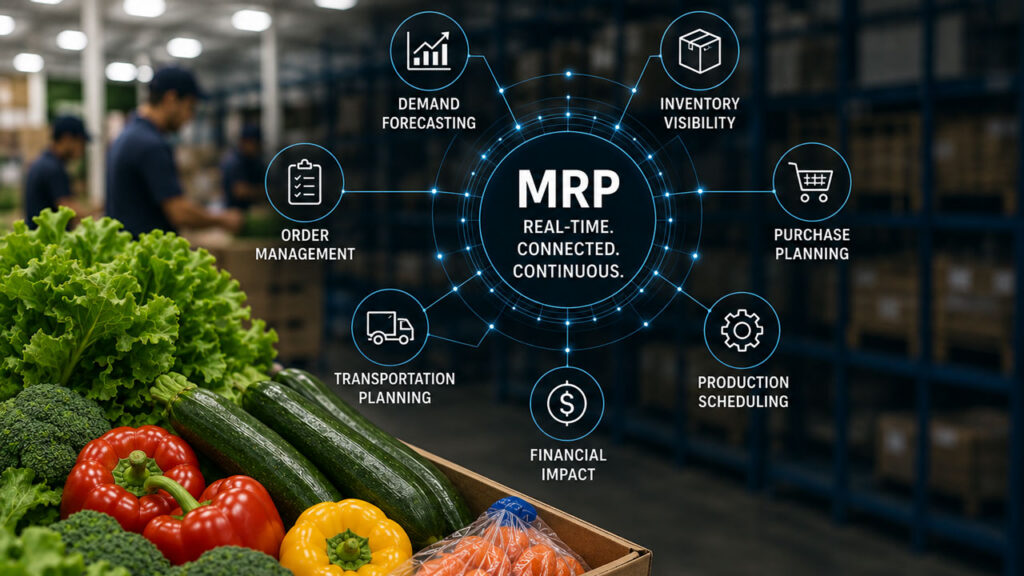
Because planning doesn’t happen inside one department.
It touches every part of the business.
- Procurement.
- Production.
- Inventory.
- Warehousing.
- Sales.
- Logistics.
- Finance.
When one decision changes, every department should already understand the impact.
Confidence Is Becoming the New Competitive Advantage.
For years, produce businesses have accepted uncertainty as part of the job.
Waiting for information.
Double-checking allocations.
Reconciling spreadsheets.
Confirming inventory.
Verifying purchasing.
None of those activities move the business forward.
They simply compensate for systems that cannot keep pace with the operation.
Modern Produce MRP changes that equation.
Automation captures information as it enters the business.
Artificial intelligence reduces repetitive administrative work.
Planning adjusts continuously.
Departments remain aligned.
Experienced people spend less time searching for answers and more time applying their knowledge where it matters most.
Technology doesn’t replace judgement.
It strengthens it.
This Is Where Produce MRP Becomes Different.
Many ERP systems include elements of MRP.
Few are designed to make MRP the operational engine that drives the business.
At Prophet ERP, Produce MRP has been developed specifically for the realities of fresh produce.
Rather than treating planning as a standalone function, it connects procurement, inventory, production, warehousing, sales, logistics and financials into one continuous planning process.
The objective isn’t simply to generate recommendations.
It’s to determine exactly what the business needs, when it needs it, while ensuring resources are planned and balanced across the entire operation.
That’s the difference between software that includes MRP…
…and software you can trust to run your operation.
Perhaps It’s Time We Asked a Better Question.
For years the industry has asked:
“Does your ERP have MRP?”
Perhaps the better question has always been:
“Does your MRP truly understand produce?”
Because fresh produce has never needed more features.
It has needed planning built around the way produce actually works.
When that happens, planning changes.
Confidence changes.
Performance changes.
And suddenly, the unexpected doesn’t stop the operation.
It simply becomes part of the plan.
See Produce MRP in Action
Discover how Prophet’s purpose-built Produce MRP helps produce and floral businesses plan with confidence.

Book a Personalized Produce ERP Demonstration

Prophet
Contacts
Address
Westlake Gardens 1, Suite 205, 2535 Townsgate Road, Westlake Village, CA, US
Website
visitProphet
Contacts
Address
Westlake Gardens 1, Suite 205, 2535 Townsgate Road, Westlake Village, CA, US
Website
visit