
Michigan Produce Fulfills the Seasons
June 23, 2026 | 6 min to read
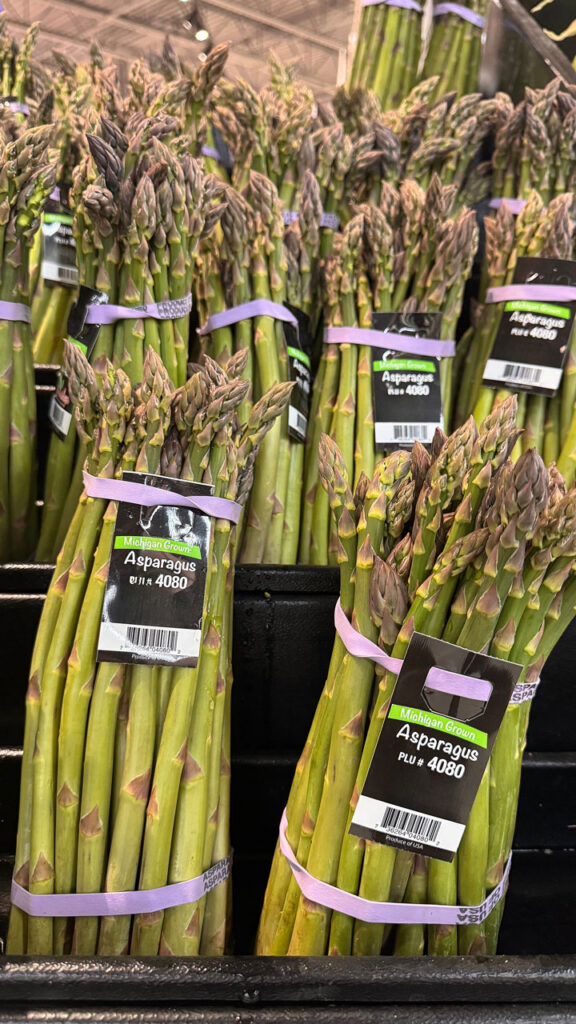
Growers deliver a diverse lineup of fresh produce, from asparagus and berries to apples and parsnips.
Michigan’s climate and geographic location help drive its diverse agricultural production. The Great Lakes play a major role by moderating temperatures and providing moisture, while the state’s central Midwest location impacts freight costs and shipping efficiency.
EARLY ASPARAGUS
The crown jewel of Michigan produce — asparagus — typically begins the prolific vegetable season.
Jamie Clover Adams, executive director, Michigan Asparagus Advisory Board (MAAB), reports in mid-May, “The 2026 Michigan asparagus season is beginning to take shape, with harvest underway across the state and pacing influenced by recent weather conditions.”
“New recipes and videos will highlight the versatility, flavor, and freshness of Michigan asparagus, showcasing how it can elevate everything, from quick snacks to complete meals, as a complement to everyday dining.”
Retailers are encouraged to access the MAAB, DeWitt, MI, for point-of-sale materials to support in-store promotions.
Adams suggests placing asparagus in weekly ads and holding store tastings. “If people try eating it, they like it, and will buy it.”
Trish Taylor, marketing manager, Riveridge Produce Marketing, Sparta, MI, says, “We are currently in full swing with asparagus season and will soon transition into sweet cherries.”
NEW BERRIES
MBG Marketing, Grand Junction, MI, is the world’s largest marketer of fresh and value-added blueberries.
“MGB represents generations of growers, families, and friends who share a common passion for growing the best blueberries in the world,” says Brian Bocock, chief executive officer. “The crop this year is strong compared to last year. We expect it to be great when Mother Nature cooperates with the supply and great quality.”
In testing new varieties, he reports, “We’re really excited with the quality and volume of Envoy, and we’ll see how it performs in the marketplace.”
Consumers, he notes, look for color, flavor, firmness and size. “They buy blueberries with their eyes.”
APPLES
Gretchen Mensing, director of communications and marketing, Michigan Apple Committee, Lansing, MI, says Michigan apples are grown on approximately 850 family-run farms, many in their fourth and fifth generations.
In 2025, 30 million bushels were produced. “This year, growers are reporting positively from their orchards, and are thankful for a mostly mild spring,” says Mensing. “While there have been some frosts during bloom, it’s difficult to tell yet what, if any, damage has taken place. By August, we will have a better idea of what is expected for the 2026 crop.”
Honeycrisp, Gala, Fuji, and Red Delicious are the most popular varieties, with Gala being the most produced. EverCrisp and Ambrosia continue to gain popularity.
Regarding sales, she notes, “Mainly Michigan apples are sold in Michigan, the surrounding Great Lakes region, and south to Florida.”
Riveridge’s Taylor says apples thrive in Michigan’s climate. “Warm summer days followed by cool, early fall nights help develop the sugars that create firm, sweet, high-quality fruit. We are proud to provide fresh apples year-round, along with fresh-pressed cider.”
She adds, “To ensure consistent quality, we utilize the latest packing and sorting technology, including AI-driven systems that accurately size and identify defects in apples and cherries. This allows consumers to simply grab-and-go and get on with their day and have nutritious food on hand.”
MYRIAD CHOICES
Michigan’s agricultural profile covers a wide range of products. Only California ranks higher.
The Michigan State University Extension’s availability guide lists 16 fruits and 28 vegetables. Ranking first, Michigan produces about 50% of the country’s asparagus, about 30% of cucumbers, and 25% of the squash. As the second largest producer of dry beans, it is also a major producer of potatoes, snap beans, bell peppers, cabbage, pumpkins and more.
The varying types of Michigan soil — particularly muck and sandy — allow Michigan farmers to flourish an array of crops.
Michigan pioneered the celery industry in the Kalamazoo area in the 1850s. Today, the state is the second-largest producer.
“The fresh market ready-to-eat celery did well early this year with floating row covers,” says Justin Lutke, general manager of the Michigan Celery Promotion Cooperative, Inc., Hudsonville, MI.
Since the early ’70s, Miedema Produce, Inc., Hudsonville, MI, has been growing, packing, and shipping radishes. From this beginning crop, Miedema now grows over 50 vegetables and ships all over the U.S. and Canada. Their Arizona facility, from November to May, augments their June to November Michigan season for all-year availability.
Specializing in root crops, they provide customized packs and cuts, such as trimmed radishes, parsnips, chips, and more, to reach the highest standards.
“We have worked hard over the past decades to position ourselves as a ‘one-stop shop’ for many of our buyers,” says Todd Miedema, principal.
They provide private labeling, contract packing, and marketing services on specific data to boost sales. “When it comes to produce, freshness is the name of the game,” he says.
Rice Lake Farms, Grant, MI, specializes in non-GMO vegetables, including over half a dozen squash varieties. Rick Sible, development and food safety general manager, says parsnips are their No. 1 crop. “The quality is outstanding because of its milky-white color,” he says.
Sible suggests retailers show their attractive vegetables in an open-air vegetable display with sales by the pound. “Let customers pick out their choices — many want to personally select which to purchase.”
Grower, packer, shipper, Tom Greiner Farms, Hart, MI, supports and promotes Michigan agriculture to create year-round category opportunities that help growers thrive in an ever-evolving market.
Its crops include asparagus, sweet cherries, zucchini, sweet corn, apples, pumpkins, hard squash and evergreens. Co-owner Sarah Greiner describes their marketing features that innovate techniques to preserve freshness and flavor.
“Maintaining a cold chain for sweet corn is essential for freshness and sweetness,” says Greiner.
Michigan enterprises support and promote the agriculture industry with product delivery, assisting in maintaining freshness, and evaluating the market.
Ken Korson, apple category manager of grower-shipper, North Bay Produce, Traverse City, MI, explains, “North Bay has made significant investments in packing sheds, packing lines, and controlled atmosphere (CA) storage technology. These improvements allow us to maintain exceptional quality, extend freshness, and deliver a premium product to customers year-round.”
He adds that apples are the primary year-round focus in Michigan due to consistent consumer demand and the ability to maintain a quality supply throughout the year.
According to Korson, North Bay represents Gala, Honeycrisp, Red Delicious, Golden Delicious, Pink Lady, McIntosh, Jonathan, Jonagold, Paul Red, Ginger Gold, Ambrosia, EverCrisp and Ida Red.
Also, he indicates that new varieties are important in today’s marketplace. “Varieties, such as Pink Lady, Ambrosia, and EverCrisp, provide eating quality and help diversify our offerings, giving retail customers a stronger and more competitive product mix.”
He adds, “We work closely with buyers to develop programs that help drive sales and meet consumer demand. Examples include tote bag promotions, bulk apple bin displays, and customized strategies to increase visibility and movement at retail.”
FUTURE DEMAND
Dominic P. Riggio, president, Riggio Distribution Co., Detroit, MI, forecasts, “The demand for all produce will continue to increase, including Michigan produce.”
Korson predicts that Michigan’s apple industry is expected to continue growing, as many orchards are just now reaching full production maturity.
“Michigan has always produced high-quality fruits and vegetables, and is entering its peak season, so we expect demand to grow in the coming months,” says Bill Loupée, chief operating officer, Ben B. Schwartz & Sons, Detroit, MI.
7 of 17 article in Produce Business June 2026
Have a story to share?
Take a place at Produce Business