
Vidalias Spark Sweet Sales Surge
April 6, 2026 | 8 min to read
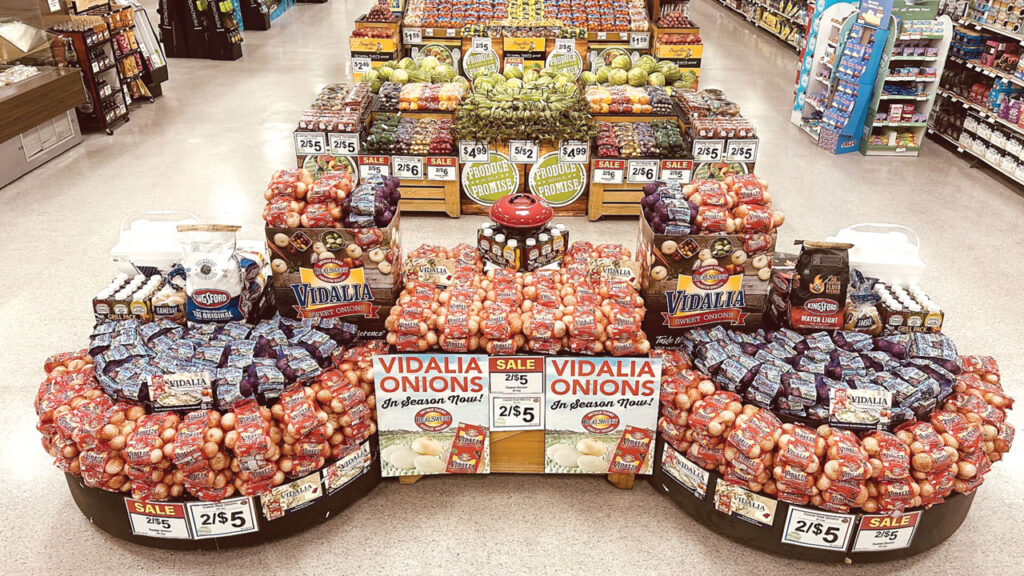
Limited-time availability and brand recognition make Vidalia onions a driver for retailers.
Today, the produce world provides supermarket shoppers with a 365-day supply of fresh fruits and vegetables. Yet the industry still has some seasonal excitement up its sleeve: Vidalia sweet onions are one.
While sweet onions are now in the market year-round, Vidalias are available only from April to August. A registered trademark and legally defined by the Vidalia Onion Act of 1986, Vidalias are grown exclusively in a federally regulated 20-county region of southern Georgia where low-sulfur soils and climate produce a sweet, mild onion without the heat of other varieties.
And that Vidalia season is highly anticipated. “We still get the question from shoppers, ‘When are Vidalia onions coming in?’” says Jeff Cady, vice president of produce and floral at Northeast Grocery, Inc., the Schenectady, NY-headquartered parent company of Market 32, Price Chopper and Tops Friendly Markets.
Cody says the anticipation is strongest among Gen X and Baby Boomers, as Millennials have grown up with sweet onions available year-round, “and I don’t think that they know when the Vidalias begin or end. That said, the Vidalia Onion Committee does a great job marketing this onion.”
GEAR UP FOR VIDALIA SEASON
“Vidalia onions are the only vegetable with an official ‘birthday,’” says Matthew Kulinski, deputy director of marketing for the Georgia Department of Agriculture (GDA), in Atlanta, GA. “This is because they can’t be sold until the annual pack date is set to ensure peak quality.”
A panel appointed by the GDA meets in March to evaluate crop conditions and recommend the expected peak maturity. Based on that recommendation, the commissioner sets the official pack date, which has not been announced as of presstime.
“Historically, Vidalia onions are available from mid-April through August or early September, and we expect the 2026 season to follow a similar window,” says Cliff Riner, vice president of ag production and grower relations for G&R Farms, in Glennville, GA.
In late January, John Shuman, president and chief executive officer of Shuman Farms, in Reidsville, GA, said their 2026 Vidalia crop was “coming along nicely.”
A sunny, dry fall yielded exceptional seedling health on the plant beds, he explains, and that strong start triggered a great set during the transplant process, which resulted in a very good stand count. “We are pleased with the size, consistency, and health of the crop to date.”
Normal spring conditions “should translate to solid promotable volume and a good size range that works well for both retail and foodservice,” says Chelsea Page, director of marketing and compliance for the Vidalia Onion Committee (VOC), in Vidalia, GA.
Vidalias are distributed widely across the U.S., Canada, and select Caribbean markets, according to Troy Bland, chief executive officer of Bland Farms LLC, in Glennville, GA. “Consumption of Vidalia onions continues to grow, and they play an important role in lifting the overall onion category. It’s our hope to be able to make Vidalias the belle of the ball for six months of the year in the future.”
“Consumption of Vidalia onions continues to grow, and they play an important role in lifting the overall onion category. It’s our hope to be able to make Vidalias the belle of the ball for six months of the year in the future.”
Troy Bland, Bland Farms LLC, Glennville, GA
For wholesale buyers and supermarket retailers, Vidalia onions offer several key advantages, adds Steven Shuman, general manager and vice president of sales for G&R Farms, in Glennville, GA.
“The official pack date creates a natural seasonal launch that retailers can promote as a ‘first of the season’ event,” Shuman notes. “Their versatility allows them to be sold in bulk, bags, and secondary displays, supporting strong movement across multiple price points. Because consumers trust the Vidalia name, retailers often see repeat purchases and increased basket rings during the season.”
“The official pack date creates a natural seasonal launch that retailers can promote as a ‘first of the season’ event.”
Steven Shuman, G&R Farms, Glennville, GA
ORGANICS — IN DEMAND
Organic Vidalia onions are more challenging to grow, says the VOC’s Page. Therefore they make up a relatively small portion of the overall crop, representing 3% to 5% of total acreage.
Demand for organic Vidalia onions remains steady and is largely driven by retail, according to Bland, who adds that approximately 6% of the grower’s crop is organic. “Shoppers who already seek organic produce respond well to Vidalias, and the organic option allows retailers to extend the season’s appeal while meeting expectations for flavor and sweetness within the organic set.”
At G&R Farms, about 10% of its onion production is currently organic, and that share continues to grow as demand increases.
“Organic onion production requires careful management and planning,” says Shuman. “Still, demand is consistent and long-term, particularly from retailers seeking to offer both conventional and organic Vidalia options throughout the season.”
SELL MORE IN-STORE
Eye-catching spillover displays of Vidalia onions are popular in season at Robért Fresh Market and Lakeview Grocery, an eight-store chain based in New Orleans, LA. “We’ll build the display in a prime location,” says Terry Esteve, produce and floral director.
“Because of the incredible recognition Vidalia onions have, this allows an opportunity for retailers to capture additional sales if displayed properly and signed effectively,” says Lisa Fetterhoff, director of operations and Vidalia commodity manager at Keystone Fruit Marketing, in Greencastle, PA, which offers Vidalias in 40-pound colossal and jumbo cartons, as well as all consumer bags.
G&R’s Farms’ Shuman suggests several effective cross-merchandising examples: a grilling display pairing Vidalia onions with ground beef, burger buns and condiments, supported by simple recipe ideas; a fresh meal solution set with Vidalias alongside tomatoes, cucumbers, avocados, and herbs for salads and salsas; or a comfort-food display featuring Vidalias with potatoes, broth, and cheese to inspire onion soups and roasted side dishes.
Shuman Farms offers its retailer partners a range of marketing resources, including social media toolkits, in-store signage, high-graphic display bins, merchandising tips for produce managers and merchandisers, and cross-promotional programs. These resources are designed to educate consumers about Vidalias’ versatility and ease of use in everyday meals, as well as their unique flavor profile and origin story.
TURN LIMITED TIME AVAILABILITY INTO ACTION
Retailers gain support and resources to promote Vidalia onions from local growers, state-based, and marketing order-entrusted organizations.
“We use close collaboration between our sales and marketing teams to provide retailers with the support they need to push programs successfully,” says Bland Farms’ Bland. “This season, our marketing and promotional support includes a retail marketing toolkit with ready-to-use assets such as social content, digital ads, signage, and promotional messaging that retailers can deploy across their own channels.”
The Georgia Grown program helps support the Vidalia season through public relations, seasonal storytelling, and promotions that highlight Georgia farmers and the start of spring cooking.
“This year’s promotional theme centers on building seasonal excitement and showcasing the ultimate grilling combination: premium Certified Angus Beef paired with the unmistakable sweetness of Vidalia Sweet Onions. Together, we’re promoting complete, flavor-forward meal solutions that inspire shoppers and elevate spring and summer menus,” says the VOC’s Page.
Through coordinated digital campaigns, recipe-driven storytelling, and seasonal marketing support, the collaboration is designed to increase visibility, encourage cross-merchandising, and drive larger basket rings during peak demand.
BY THE NUMBERS
- Last year, approximately 275 Georgia growers, nearly half of whom grow on 10 acres or less, planted 10,000 acres and harvested an estimated 125 million pounds of Vidalia onions.
- The crop’s annual value is approximately $150 million, representing about 40% of the total sweet onion market in the U.S.
Source: Georgia Department of Agriculture
* * *
Vidalias on the Menu: The Onion’s Versatility Appeals to Foodservice
For the fourth consecutive season, Shuman Farms is turning up the heat on foodservice by spotlighting Vidalia onions during its annual “Champagne of Onions” Restaurant Week in May.
The Reidsville, GA-based grower and marketer partners with a regional foodservice distributor to place Vidalia onions in the hands of leading Georgia chefs who feature the onions on limited-time menus built around the crop’s signature sweetness.
The promotion underscores how seamlessly Vidalia onions translate from the field to fine dining, giving operators a premium, seasonal ingredient that elevates everything from starters to center-of-the-plate entrées while generating consumer excitement during peak availability.
Murphy’s, which serves contemporary American comfort food in Atlanta’s Virginia-Highland neighborhood, has partnered with Shuman Farms on Restaurant Week for three years.
“Chef Matt McCarthy created two recurring fan favorites: Vidalia Onion Soup and a Vidalia Onion Flatbread,” says John Shuman, president and chief executive officer of Shuman Farms. “The flatbread is a fitting example of the Vidalia onion’s versatility. He uses Vidalias three diverse ways in one dish: fresh, blended into a spread, and infused into a honey that’s drizzled on top.”
The Vidalia’s versatility is central to its foodservice appeal.
“Their naturally sweet, mild flavor makes them easy to incorporate across a wide range of dishes,” says Steven Shuman, general manager and vice president of sales for G&R Farms, in Glennville, GA.
Operators lean into classics such as caramelized toppings for burgers, French onion soup, and onion dip, while chefs are expanding usage into grilled onion steaks, relishes, jams, compound butters, infused honeys, pickled garnishes, and crispy toppings to layer flavor throughout a dish. Most recently, an extra creative use was in making French Onion Dip Danish, taking a nostalgic, savory flavor profile, and putting the sweet onions into a bakery item.
Seasonality requires advance planning. Vidalias are available only in spring and summer, and their higher moisture content compared to storage onions requires careful handling. Yet that defined window is also a strength.
“Vidalia onions are a great fit for foodservice, especially as a seasonal menu feature,” says Chelsea Page, director of marketing and compliance for the Vidalia Onion Committee (VOC), in Vidalia, GA. “The biggest challenge is timing, but that’s also part of the appeal.”
Promotion strategies are straightforward.
“The simplest and most effective way for operators to promote Vidalia onions is to name them on the menu and position them as a limited-time feature,” says Page. “When servers and staff can talk about the sweetness and where it comes from, it resonates with guests.”
7 of 19 article in Produce Business March 2026
Have a story to share?
Take a place at Produce Business