Sweet Onions: Year-Round Draw
April 27, 2026 | 9 min to read
Spring and summer bring added revenue from onions in produce.
A high-interest segment within the onion category, sweet onions maintain a loyal consumer following and offer strong shopper pull and dependable produce profitability.
Constituting more than 30% of all onion sales, sweet onions provide retailers with an additional option to traditional onion offerings. To accommodate shopper demand and encourage movement, suppliers recommend stores provide twice the amount of display space for sweet onions compared to storage onions.
“They have become a basic item,” says Marc Goldman, produce director for Morton Williams Supermarkets, a metropolitan New York chain based in Bronx, NY. “It used to be just Vidalia in season, but now with all the imports, it’s a year-round item. It’s become a regular item, same as Spanish onions or red onions. Whenever you have an item that moves all around, it’s an important item for your business.”
Attracted by the onions’ signature flavor profile, consumers eagerly await and actively seek sweet onions’ arrival on store shelves.
“Sweet onions are among the most consistent sellers in the produce department,” says Kelsey Weingart, brand manager/marketing for Peri & Sons Farms Inc., Yerington, NV. “They sell at a premium price, compared to conventional yellow or white onions, resulting in higher margins per-unit. Shoppers actively seek them out by name, which builds destination traffic in the produce aisle. They also appeal to a broad customer base, from everyday home cooks to health-conscious shoppers looking for clean, flavorful ingredients.”
“Because sweet onions deliver on flavor, quality and versatility, they generate repeat purchases and help anchor the onion category as a whole.”
— Kelsey Weingart, Peri & Sons Farms Inc., Yerington, NV
For domestic sweet onions, South Texas growers begin shipping by late March, and in Georgia, this year’s official Vidalia pack date is April 13. In late spring, smaller sweet onion deals from California and New Mexico start, then Washington’s Walla Wallas arrive in supermarkets in mid- to late June. Nevada growers initiate harvesting in late August, as Vidalia availability closes by Labor Day, when Peru arrivals begin and ship through February, when Mexican production typically commences.
Sweet onions, particularly Vidalia onions, function more like a branded produce item than a commodity SKU (stock-keeping unit), often generating higher velocity and supporting stronger average retail prices across the onion set during peak season, says Chelsea Page, director of marketing and compliance for the Vidalia Onion Committee (VOC), in Vidalia, GA.
“Vidalia onions deliver premium price realization and higher per-pound margins while creating seasonal excitement that drives display activity,” says Page. “Their strong consumer recognition generates consistent pull-through at retail. For retailers, they represent a clear trade-up opportunity within the onion category while energizing total category performance.”
SEASON GREETINGS
Grilling season, holiday entertaining, and game-day gatherings are among the strongest demand windows for sweet onions. Supermarkets building promotions around these moments can experience consistent volume lifts.
“Sweet onions are a major driver of onion dollars at retail because they’re the variety shoppers actively look for when they want a mild, versatile option for everyday meals,” says Dante Galeazzi, marketing order manager of the South Texas Onion Committee (STOC), Mission, TX. “They typically make up around 35% of total onion sales, which is significant to overall category performance — especially during spring and grilling season when onion usage spikes in burgers, salads, sandwiches and sheet-pan meals.”
Sweet onions are a high-margin item and the base of countless recipes and meal solutions, says John Shuman, president and chief executive officer of Reidsville, GA’s Shuman Farms.
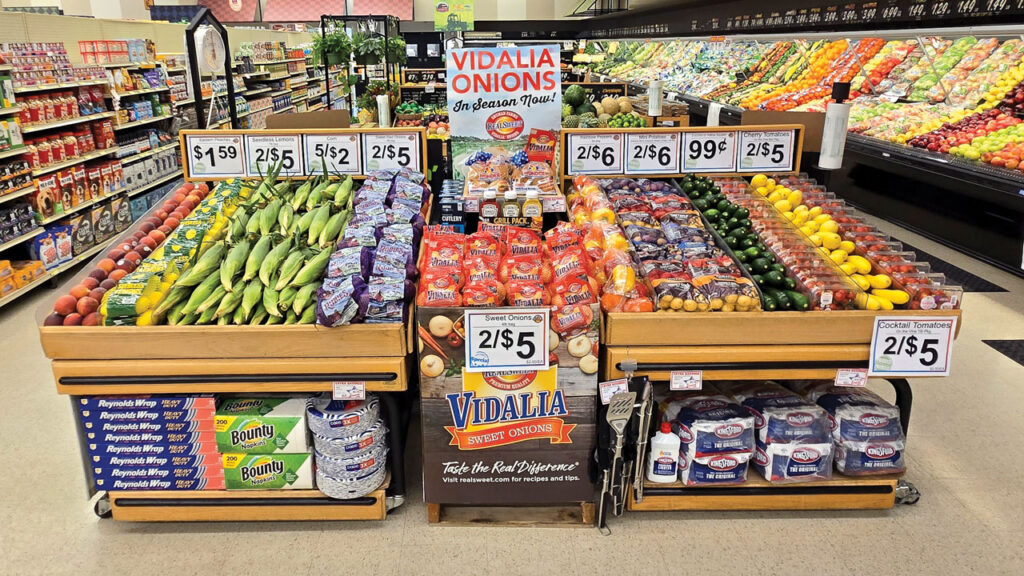
“Retailers can capitalize on sweet onions’ popularity with strong merchandising and proper labeling at the shelf,” he says. “On average, sweet onions are the onion category driver for retailers throughout North America, accounting for a third of all sales.”
“Retailers can capitalize on sweet onions’ popularity with strong merchandising and proper labeling at the shelf. On average, sweet onions are the onion category driver for retailers throughout North America, accounting for a third of all sales.”
— John Shuman, Shuman Farms, Reidsville, GA
“Walla Wallas are a low sulfur content, high sugar, lots of water type of sweet onion,” says Mike Locati, owner-operator of Locati Farms, Walla Walla, WA. “It’s a sweet-tasting kind of wonderful experience to eat one, especially on your burger or your salad or whatever else. You can pair it up with another item or prepare it by itself as an onion ring or something else. Sweet onions have a far superior taste and quality when you’re comparing that to a yellow onion.”
Little Bear Produce, based in Edinburg, TX, grows and markets HoneySweet Onions throughout the year.
“Their (sweet onions) versatility lends themselves to a lot of different things,” says Jeff Brechler, chief of sales and marketing. “While a sweet onion doesn’t give you the color that a red onion would, flavor is going to be what sells it. Onions will never be center plate. So, they’re always going to have to complement something. The beauty of a mild onion or sweet onion is that it can be used in salads, sliced and put on sandwiches, not just burgers, but other things, like hot dogs or in any recipe, really.”
Vidalia sweet onions are a dependable driver in the produce department because shoppers recognize them and look for them by name, says Sloan Lott, director of sales for Bland Farms LLC, based in Glennville, GA.
“They deliver strong velocity, consistent quality, and versatility across multiple merchandising opportunities — from grilling displays to everyday meal solutions — helping retailers build repeat sales and maintain momentum in the onion category,” Lott says. “For shoppers, Vidalia sweet onions are a household staple they trust. Consumers know what to expect, and that confidence keeps them coming back to the category.”
FLAVOR ADVANTAGE
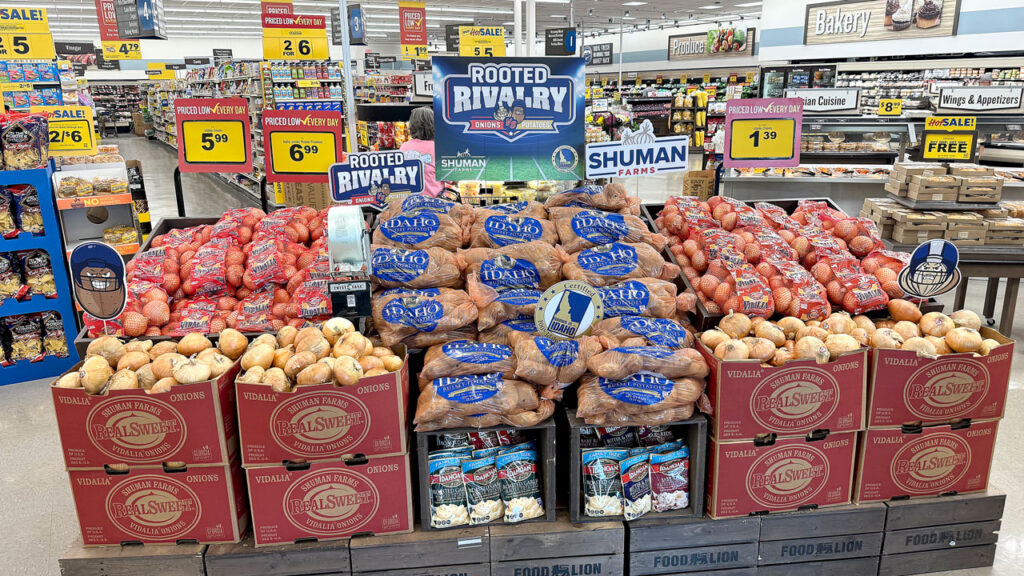
Large displays, with unique signage and graphics highlighting the flavor profile and attributes of Vidalia and other sweet onions will push sales, says Jarrod Snider, director of commodity development for Richter and Co., Charlotte, NC.
“Place them front and center with large displays such as spillovers,” he says. “Key promotional windows, such as Memorial Day and Independence Day, help drive sales and volume. They (sweet onions) are a unique item with a different flavor profile and should be merchandised as such.”
The popularity of value-added meal accompaniment kits, including barbecue packs and fajita mixes, allows retailers to increase onion sales, as well as other items, including bell peppers, mushrooms and zucchini squash, says Megan Jacobsen, vice president of sales and marketing, Gills Onions, LLC, an Oxnard, CA-based fresh-cut processor.
“There definitely is a taste, flavor and texture difference,” she says. “Consumers like cooking with all types of onions, but the sweet onion changes the flavor of your recipe. It definitely has its market.”
Today, digital promotions are more important. Featuring sweet onions in email newsletters, social media posts, and loyalty app promotions, reaching shoppers before they walk in the stores, encourages shoppers to place sweet onions on their lists before hitting the produce section, says Peri & Sons Farms’ Weingart.
“Digital integration also matters more than ever,” she says. “Retailers who run features in their weekly ads alongside recipe suggestions consistently see volume lifts. The most important thing retailers can do is educate the shopper at the point-of-sale. Many consumers do not fully understand the difference between a sweet onion and a conventional onion, so clear signage that communicates flavor profile, mild taste, and versatility goes a long way.”
Sweet onions can find a place with many other produce items, and Grant Werner, produce buyer for Heinen’s, a Warrensville Heights, OH, chain of 24 stores in northern Ohio and Illinois, believes cross-merchandising is a good way to market sweet onions.
“All those tie-in items (work well),” he says. “When customers see the items that go together when making salsa, guacamole, stews and soups, it really does entice them to grab a couple other items on display to complete their meal solution.”
DON’T STAND SO CLOSE
Sweet onions perform best when they are merchandised separately from storage onions and supported with clear, branded signage.
“Vidalias perform best in standalone, high-visibility endcaps, with secondary placement in areas like the meat or deli departments to support meal planning and drive incremental sales across the store,” says Bland Farms’ Lott.
“The more space retailers give sweet onions, the more the category performs. Ideally, they should receive at least double the space of other onion segments to match demand and maximize movement.”
Werner agrees proper display space is necessary for effective sweet onions merchandising.
“You need to pick something that fits your needs and give it the display space to do well; do not hide it,” he says. “For displays, we prefer our bin sets with side tables to wing items on. It really depends on your store’s space, the amount of space allocated to the item.”
The push for sweet onions during the domestic season should be marked by larger bulk displays. Storage onions should be de-emphasized during the summer, when sweet onions move in peak volumes, advises Little Bear Produce’s Brechler.
“During the domestic season, opt for your Spanish-type onions to be sold only in 2- or 3-pound consumer bags,” he says. “That way, you can drive the consumer toward a bulk display, not to hammer the other guys, but to highlight sweet onions.”
DISTINGUISHING FEATURES
Differentiating sweet onions in the produce department and keeping accurate PLU stickers on them remains important for sales, says Locati Farms’ Locati.
“In the store, sometimes it gets convoluted and difficult when all onions are put in the same place,” he says. “But it’s not like you want your produce all over; you don’t want people hunting and picking for it. But sometimes, when a yellow onion sits next to a sweet onion, or a sweet onion isn’t really differentiated because it’s in a bag, it’s difficult for the consumer to see that.”
During the late spring and summer, when Vidalia onions are in season, Shuman Farms encourages its retail customers to ensure their shelf tags call out “Vidalia” to capitalize on the Georgia-grown sweet onion’s brand loyalty and create excitement for the seasonal offering.
“Displays drive sales, and sweet onions are no stranger to the strategy,” says Shuman. “Merchandise sweet onions at the front of the department, utilizing a good mixture of bagged and bulk product to meet customer needs. Place Vidalia onions at the front of the department to announce the start of the season and keep them on high-traffic endcaps throughout the spring and summer months.”
9 of 20 article in Produce Business April 2026
Have a story to share?
Take a place at Produce Business