
From Organics to Food Waste: Industry Insights Take Stage at NYPS
January 6, 2026 | 10 min to read
Organics and food waste are hot topics today. Case in point, nearly six in 10 shoppers (59%) actively seek out organic foods, according to a February 2025 Acosta Group study. Similarly, food waste ranks third (34%) among consumers’ top food-related concerns, based on the 2023 MITRE-Gallup report, The State of Food Waste in America, behind food prices (81%) and the healthfulness of what they eat (56%).
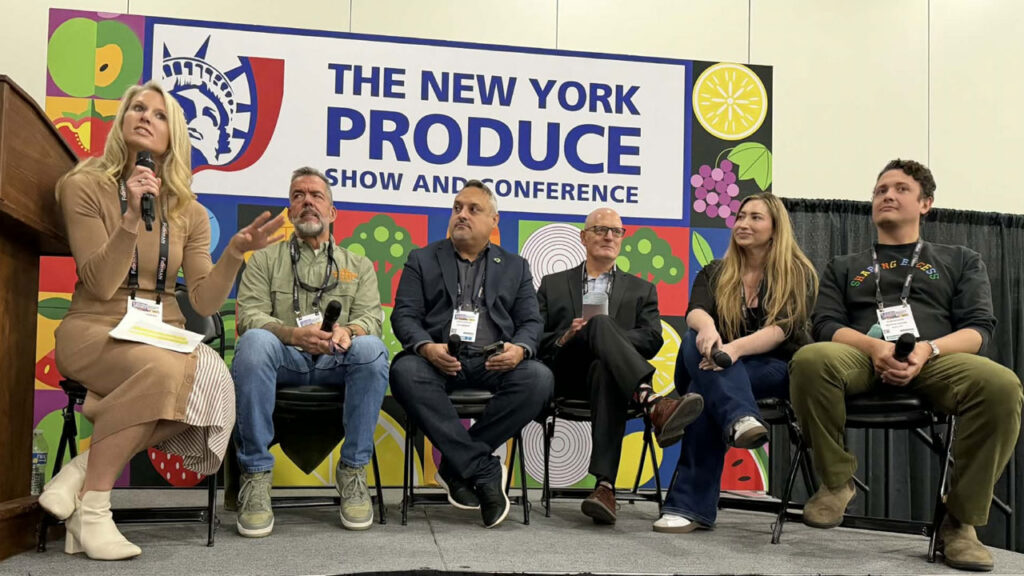
Both subjects took the spotlight during morning sessions on the Industry Insights Stage at the 2025 New York Produce Show (NYPS), in panels titled “Understanding the Organics Consumer” and “Produce for Good: Effective Strategies to Conquer Food Waste in the Last Mile.”
ORGANIC GROWTH CONTINUES — WITH PRODUCE LEADING
The organics panel, moderated by Adrienne Messe, director of events at the Washington, D.C.-headquartered Organic Trade Association (OTA), opened with a clear message: Organic growth has stabilized post-pandemic and is outperforming total store sales, with produce continuing to lead the category.
The OTA’s 2025 Organic Market Survey showed total U.S. organic sales reached $71.6 billion in 2024, up 5.2% year over year. This is the highest growth rate since 2020. By comparison, total store sales grew just 2.5%. Organic produce accounted for 30.1% of organic food sales, totaling $21.5 billion.
“Produce is the largest organic category and often the entry point for shoppers buying organic for the first time,” Messe said.
Panelists pointed to berries as a growth engine, with organic berry sales rising 10.3% in 2024. Bananas also gained, posting 15.5% growth. Apples, carrots, potatoes and citrus also showed steady gains, reinforcing produce’s role as the most penetrated organic category.
Danelle Huber, senior marketing manager at CMI Orchards in Wenatchee, WA, discussed the investment required by growers to meet demand, noting that certification, labor, and orchard management costs require long-term planning.
“We’re about 15% to 20% organic today, and that number will increase as conventional orchards transition,” Huber said.
From the distribution side, Eric Mitchnick, director of organic and specialty at D’Arrigo New York, located at the Hunts Point Market, said organic programs have expanded steadily among larger conventional growers over the past decade.
“If retailers want to build organic programs, we work backward through the supply chain to support it,” he said, noting strong demand in berries, salads, citrus and tropicals.
Retail execution remains a moving target. Noelle Neary, produce category manager at Wakefern Food Corp., in Keasbey, NJ, the largest retailer-owned grocery cooperative in the U.S., said the company now carries more than 365 organic SKUs across banners.
“We’re constantly evaluating whether to integrate or segregate organic displays,” Neary said. “How shoppers find organic impacts performance.”
Education emerged as a consistent theme. OTA research shows consumers who understand organic certification are more willing to pay a premium. While about two-thirds of shoppers expect organic to cost roughly 20% more than conventional, confusion about competing claims continues to challenge perceptions of value.
OTA’s new consumer campaign, called “Seal Makes It Simple,” aims to simplify messaging by reinforcing what the USDA organic seal already represents. The campaign will run through December 2026.
FOOD WASTE: SOLVING THE LAST-MILE BREAKDOWN
While the organics panel focused on growth, the food waste session centered on efficiency. Moderated by Garland Perkins, founder of Fresh Endeavors Consulting, the discussion examined how coordination, communication and infrastructure determine whether surplus produce feeds people or ends up discarded.
Carlos Rodriguez, president of City Harvest in New York City, placed food waste in the context of affordability. “We’re seeing 47 million pantry visits a year — up from 25 million in 2019,” Rodriguez said. “Two-thirds of those households have a working income. When rent takes priority, food quality becomes negotiable.”
Bob Silvia, chief procurement and operations officer at Food Bank for New York City, described the importance of speed and familiarity. “If people don’t know how to use a product, it doesn’t get eaten,” Silvia said. “We’re moving food same day — from pickup at 5 a.m. to dinner tables at 5 p.m. — across 780 agencies.”
Operational alignment surfaced repeatedly. “If quality, quantity, and expectations don’t align, food gets rejected,” said Stevie Shandler, director of growth and sustainability at Shapiro-Gilman-Shandler in Los Angeles, CA, pointing to last-mile mismatches as a significant source of waste. “Clear SOPs prevent that.”
Technology also plays an increasingly important role, according to Evan Ehlers, founder of Sharing Excess, based in Philadelphia, PA. Ehlers described how real-time data and on-site sorting help quickly redirect surplus.
“We fill gaps at the lowest level,” he said, noting that tracking systems and tax credits influence participation.
Lastly, Dan Duguay, sustainability specialist at the Canadian Produce Marketing Association in Ottawa, Ontario, broadened the discussion to include waste hierarchy and policy. Distinguishing between predictable and incidental waste, Duguay emphasized directing food to its highest use — human consumption first — supported by refrigeration, logistics and local partnerships.
GOING FOR BROKERS
The role of brokers also remains important in the produce supply chain, as they act as a resource that supports the relationship between vendors and retailers, but also one that can help identify and address opportunities.
During the session “Going For Brokers: Why Having a Knowledgeable Partner Is Key To Success,” Paul Kneeland of Elevated Foods hosted a panel that included Brian Maguire, executive vice president of produce at JOH, Billerica, MA; Chris Hill, chief revenue officer, Little Leaf Farms, Devens, MA; and Christina Stipe, director of produce at Northeast Shared Services/Price Chopper/Market 32, Schenectady, NY.
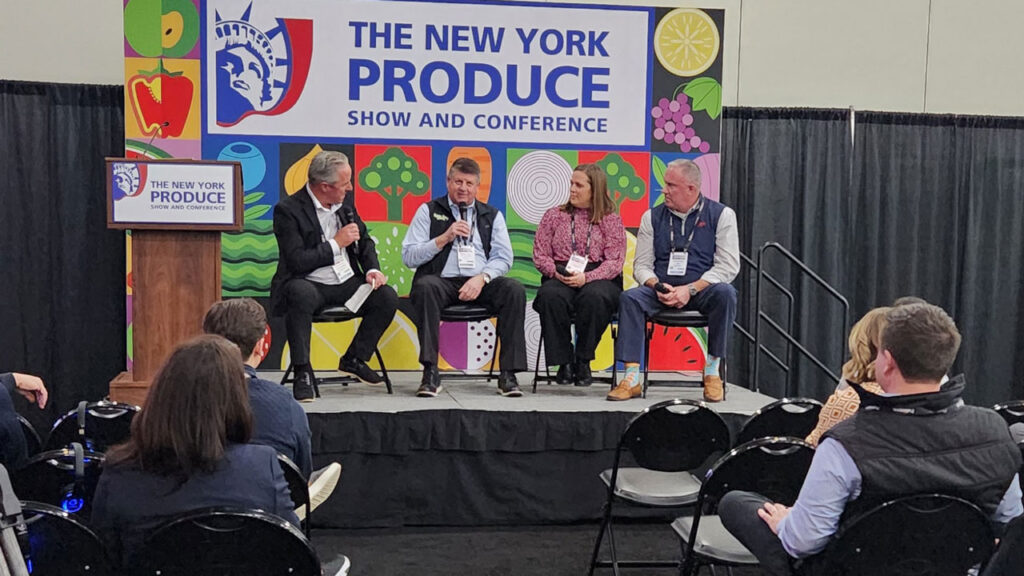
The panel acknowledged the market is challenging when it comes to everything from staffing to consumer demand to dealing with environmental considerations, but that open and supportive relationships can help keep things moving positively.
Hill commented that brokers can help suppliers and retailers stay connected. “It starts, in my opinion and our team’s opinion, with the consumer,” he said. “We really strive on finding a partner who can be an extension of our company. Somebody who can understand our goals and objectives and can partner with us to delight our customers and also our customers in the four P management of our business: products, pricing, planogram, promotion. And then setting goals and objectives that tie in with our retail partners so that together we’re building a model and we’re all on the same page.”
Hill said Little Leaf puts a real emphasis on the idea of a broker being an extension of the company and its operations, which includes having clear communications, expectations and goals. “We don’t treat it like a vendor/client relationship. We treat it like an extension of us. We find that’s the best way to success. Our ultimate goal is to win with our retail partners. When we do that, we’re all successful.”
Stipe said brokers can support internal efforts, making additional resources available. “Having a key partner in a broker allows us to let them know what success is for us, and have that come across multiple areas without us having to have each conversation separately.”
“There is an inherent knowledge base a broker team can have that can handle a lot of first, second and third conversations,” Stipe added, “so when you do get to meet with your partners, it can be really efficient because they’re always halfway there.”
Maguire said that, as the business of the brokerage has evolved, JOH has increasingly gotten into analytics. “We’re built on relationships, but I think it’s so important to have the tools in your toolbox to be successful in all aspects of the business. I think that’s where we’re trying to set ourselves apart.”
Maguire noted that trust is an important issue, with the ability to stand as a link between retailers and the vendors serving them dependent on it. “It’s a lot of work over the years in building that trust,” he said, “but making sure that we’re executing at a very high level and follow through is super important to gaining that trust.”
Stipe added that trust and understanding are fundamental throughout the supply chain. “I think it’s just as important the other way around. Chris, I’m sure, along the way, has had to make very difficult decisions on which retail partner he’s going to support when things are not plentiful, who is going to manage through that, and it’s the conversations, it’s the transparency, it’s the plan.”
Maguire said it’s important to set guardrails so all parties understand what’s happening and what’s expected. The process of give and take along the supply chain is part and parcel of the relationships involved, but transparency and trust have to remain throughout, which, when things work correctly, lends itself to profitable interaction.
Stipe noted that communications about challenges in the different segments of the supply chain are important, not only so corrective measures can be taken quickly when they are necessary, but also to align operations to opportunities as they arise. So, a solid relationship with brokers as the link between vendors isn’t only about fixing, but building as well.
CATEGORY MANAGEMENT DRIVES PRODUCE GROWTH
In the panel, “Beyond the Pile: How Category Management Drives Produce Growth,” Tom Barnes, Julie DeWolf and Cara Ammon of Category Partners pointed to ways that companies can distill research and experience using category management principles as a way to effectively optimize operations.
DeWolf, senior vice president of business development, said she has seen research and marketing done in the category management context to enhance optimization.
Given the four P’s of marketing — price, product, promotion and place — category management can function to support the connection with the consumer. Through research, analysis and practice, Category Partners works to help retailers place the right products on their shelves, at the right price in the right section of the store in a way that promotes shopper discovery and purchase. Then, to generate interest, category management practices include reviewing promotions, optimizing operations and driving volume.
“Through category management, you can do comparisons and understand the competitive landscape to see how your competition is priced, if you’re at a fair price, and how you might want to make adjustments,” DeWolf said.
In addition, through similar analysis, category management provides a means for companies to make key determinations regarding how much space a product needs in the balance.
Barnes noted that category management is empirical. “What we’re talking about is fact-based selling. In today’s world, we have so much data everywhere. The retailers have a lot of data. The problem is, they don’t have enough time to go through this and really see what’s going on.”
And that’s not the only challenge. Barnes said another problem that retailers face is that they are steeped in data from only one perspective, their own.
“They can’t see the rest of the story,” he said. “They can’t see what else is going on. So today, why we’re talking about the four P’s, about category management, is the importance of helping retailers grow their businesses.”
Internal data is the starting point. However, to provide perspectives that can improve the outcome of category management practices, outside sources of data, such as syndicated data, are important so that retailers get a true sense of what’s happening in their competitive sectors. In establishing a clear perspective, the final step is layering in consumer research.
“We get the ‘what’ with the data,” Barnes said. “We get the ‘why’ with the consumer data. When we combine those things, that’s when we get to category management.”
At that juncture, category management really becomes taking information and putting it into an effective format that is the foundation of valuable insights and action. With a greater understanding of what is happening and why in the marketplace, retailers can make more effective decisions about functions, such as promotion.
Ammon said category management and the research behind it, including path to purchase and tracking studies, can keep retail operations in line with consumer needs and perceptions. Tracking studies, for example, show “how brand awareness increases over time or how the number of people using your product is increasing over time.”
The Industry Insights Stage Educational Sessions were part of the NYPS. The one-day trade show and three co-located events were Dec. 2-4, 2025. The New York Produce Show is organized by Produce Business and the Eastern Produce Council.
SAVE THE DATE!
Mark your calendar for next year’s New York Produce Show and Conference: Dec. 2-4, 2026.
Exhibitors, book your booth now, as there’s limited time to maintain the current booth rate. Visit www.nyproduceshow.com/exhibit2026 or talk to your sales representative before Jan. 16, 2026, to lock in the 2025 rate!
Have a story to share?
Take a place at Produce Business