
Six Ways to Sell More Specialty Mushrooms
February 9, 2026 | 10 min to read
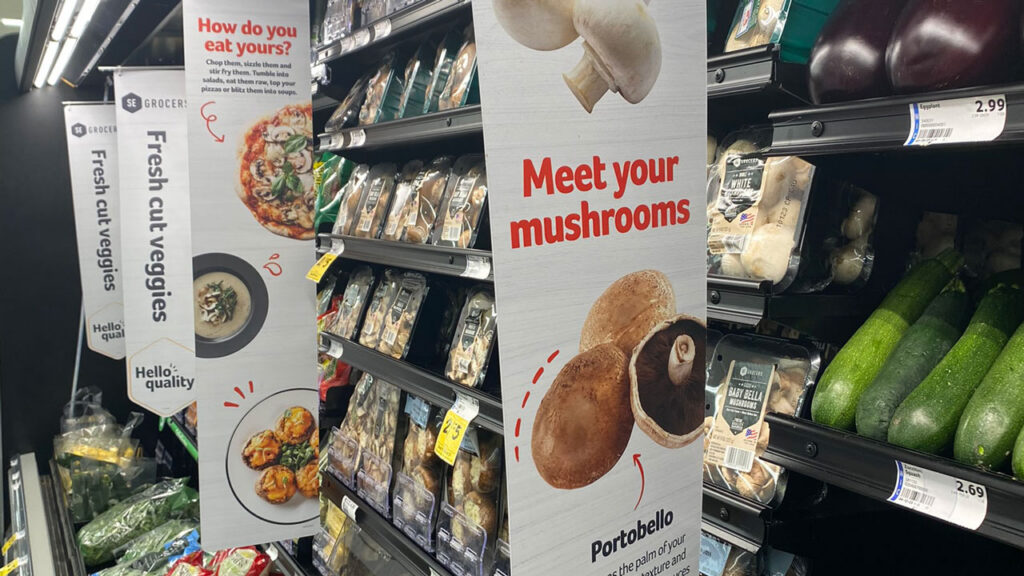
Make mushrooms a destination, and then help shoppers decide what to buy.
Specialty mushrooms are having a moment, and it’s not just on the tasting menu. Once the domain of fine dining and farmers markets, varieties like shiitake, oyster, lion’s mane and trumpet are now showing up in mainstream produce aisles, credited to a mix of foodservice inspiration and consumer curiosity. Add in health-and-wellness buzz, plant-forward eating, and year-round availability, and it’s no wonder shoppers are reaching beyond white buttons and browns for something a little more exotic.
McCaffrey’s Food Markets, a nine-store chain headquartered in Langhorne, PA, carries white, brown, specialty and dried mushrooms. Stores are within an hour or less drive of Kennett Square, PA, nicknamed the Mushroom Capitol of the World, and where most of the nation’s mushrooms are grown.
“Our customers know their mushrooms,” says Tony Mirack, produce director of operations. “As for specialties, we carry shiitakes, oysters, hen of the woods (maitake), royal trumpets, and blends containing three or four specialty varieties, each with different textures and flavors. Mushrooms are a destination category for us.”
“Mushrooms are a destination category for us.”
—Tony Mirack, McCaffrey’s Food Markets, Langhorne, PA
While white, cremini, and portobello mushrooms account for the bulk (93%) of fresh mushroom sales, specialty mushroom varieties have been an area of increased focus among consumers, retailers and chefs alike. Of note, specialty mushrooms sell more than $90 million through traditional food channels, according to data shared by the Mushroom Council, headquartered in Lee’s Summit, MO.
“Mushrooms make up about 3% to 4% of total vegetable sales and 1% to 2% of total produce sales,” says Anne-Marie Roerink, president of 210 Analytics in San Antonio, TX, and retail analyst for the Mushroom Council. “Because of their higher price per pound, specialty mushrooms represent 7% of total fresh mushroom sales and about 2% to 3% of volume sales. Specialty mushrooms are typically sold in smaller packs of about 3.5 to 5 ounces.”
Here are six ways to sell more specialty mushrooms at retail:
1. FEATURE BEST SELLERS & UP-AND-COMERS
There is a greater availability of exotic mushrooms than ever before, as both legacy farms and upstart micro mushrooms are growing more to satisfy consumer demand, according to Mark Kreiner, outside sales coordinator for Mother Earth LLC, in Landenberg, PA.
Shiitake, oyster, and maitake (hen of the woods) remain the strongest specialty mushroom movers for Phillips Mushroom Farms, in Kennett Square, PA. “Their versatility, savory umami, and mainstream recognition make them staples,” says Sean Steller, director of business development.
Phillips Mushroom Farms has expanded considerably through advancements in climate-controlled growing and infrastructure investment to supply a broader range of specialty varieties year-round in consistent volumes.
Shiitake mushrooms are the most extensive variety within specialty mushrooms, according to Roerink. “They also have the widest distribution, and have gained in distribution and sales, generating $66 million over the past year.”
What’s more, shiitake are the only specialty mushrooms to rank among the Top 20 selling mushroom SKUs by dollars, with 5-ounce sliced conventional and organic ranking at 18 and 19, respectively, according to the June 2025-published report, Top Sellers by Pack Size and Format, by the Mushroom Council. By unit sales, these two SKUs rank 19th and 20th.
Fast up-and-comers are oyster, lion’s mane, and trumpet varieties. Oyster mushrooms, for example, have grown 26% since 2020 to $8 million in annual sales, Roerink says. “With their range of colors, they are a foodie favorite to add a pop of color to dishes.”
Justin McLean, sales manager at Farmers Fresh/Premier Mushrooms, in Abbotsford, BC, says they’ve seen a rise in popularity in lion’s mane, “with its links to the nootropics and brain health trends.”
In addition to shiitakes, “maitakes (hen of the woods) are another specialty mushroom variety we carry. Both do well,” says Ben Painter, president of SPD Markets, with two stores located in Grass City and Nevada City, CA.
2. OFFER ORGANICS
Organic has a far greater presence in mushrooms (23%) than in total fresh produce (12%) or total vegetables (15%), according to Roerink, on behalf of the Mushroom Council. “Organic mushrooms are a growth area, with younger consumers leaning into organic production. Organic mushroom dollar sales reached $338 million over the past year, with increases in dollars, units, and volume.”
Demand for organic specialty mushrooms is outpacing conventional growth, according to Phillips’ Steller. “Consumers shopping in the organic produce section often seek premium, nutrient-dense items, and mushrooms fit seamlessly into that basket.”
“Consumers shopping in the organic produce section often seek premium, nutrient-dense items, and mushrooms fit seamlessly into that basket.”
—Sean Steller, Phillips Mushroom Farms, Kennett Square, PA
Mother Earth is looking to launch retail packs of Organic Mini King Trumpets, Organic Chestnut Mushrooms, and Organic Golden Enoki soon, says Kreiner. “We launched our four SKU line of organic dried mushroom pieces earlier this year, with lion’s mane, oyster, shiitake, and portobello.
3. TRY NEW SKUS
There are new varieties, new blends, and new value-added products for retail. For example, Steller says Phillips is expanding production of wood ear, chestnut and pioppino (also known as black poplar) mushrooms.
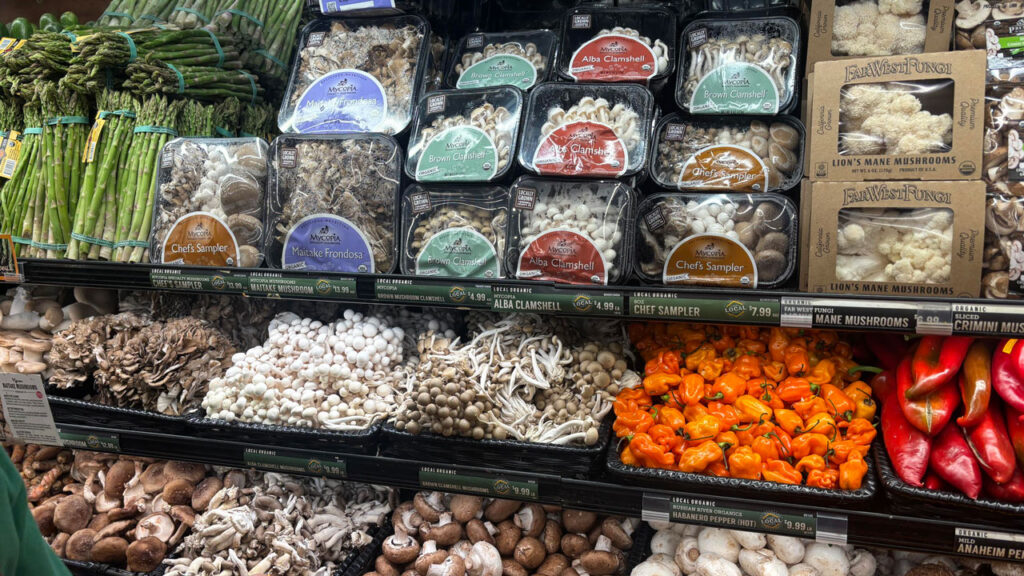
Blends, or grouping multiple varieties into one pack, are a huge trend, according to Robert Schueller, director of public relations for Melissa’s/World Variety Produce in Vernon, CA. “We’ve introduced two blends, in 6-ounce packages each. Protein Blend, with maitake, shiitake, and king oyster mushrooms, perfect for plant-based dishes, and a Grilling Blend, with shiitake, king oyster, and portobello, ideal for cooking on a grill.”
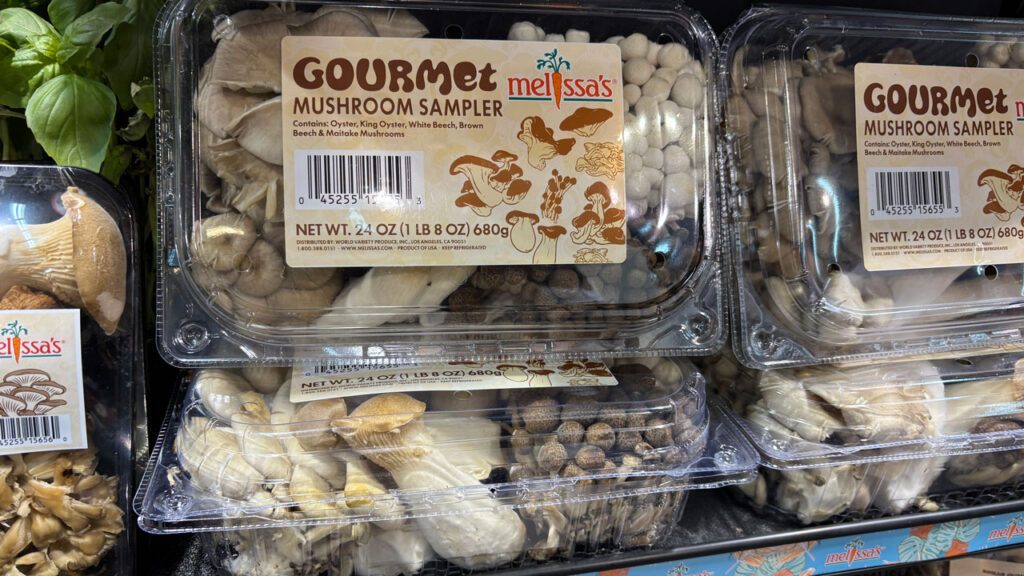
The company also offers a 24-ounce Gourmet Mushroom Sampler for retail, with oyster, king oyster, white beech, brown beech, and maitake mushrooms.
The Giorgio Fresh Co., in Blandon, PA, recently expanded its value-added offerings with Sliced Mushroom Grill Packs. The three flavors are Smokey Honey Habanero with cremini, king oyster, and lion’s mane mushrooms; Steak Seasoning with cremini mushrooms; and Brown Sugar Bourbon with cremini and shiitake mushrooms. Each is 8 ounces.
“Each pack has a foil tray that can be placed directly on a grill,” says Bryan Shelton, vice president of sales and marketing.
4. CREATE A DESTINATION DISPLAY
Retailers can successfully introduce specialty mushrooms by starting with one facing per item, keeping products fresh, and maintaining tight turns while learning store-specific demand, says Lawrence Tuck, vice president of retail category management at Monterey Mushrooms in Watsonville, CA. “This approach helps build velocity and ensures the right mix as consumer interest grows.”
Specialty varieties are visually spectacular, and that’s an essential opportunity for impulse sales.
“The colors and shapes lead to a natural curiosity to know more about the flavor and texture profile and what to do with them,” says Roerink. “In retail, dwelling is selling, and a display showing a variety of specialty mushrooms, along with consumer education, can be a great way to boost mushroom sales.”
As more retailers take advantage of the opportunity to broaden their mushroom category offerings, the Mushroom Council has developed point-of-sale signage that educates consumers about each mushroom variety and provides recipe inspiration.
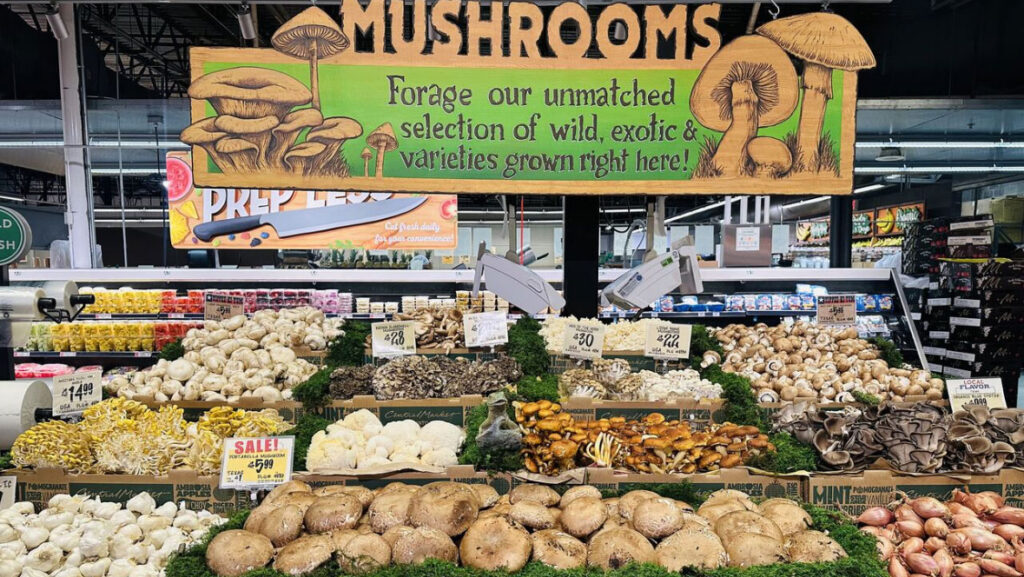
“These free resources help make the mushroom display a destination while also promoting impulse purchases,” says Cristie Mather, vice president of marketing for the Council. “For time-strapped shoppers looking for inspiration, the signage has recipe QR codes that make recipe planning and shopping a no-brainer.”
5. CREATE MEAL SOLUTIONS
Cross-merchandising is key, says Giorgio’s Shelton. “We recommend displaying specialty mushrooms alongside complementary items like sauces, dips, and proteins to inspire meal ideas and highlight versatility. This approach highlights mushrooms as part of a broader culinary experience rather than a direct substitute for white buttons, helping boost total category sales.”
Specialty mushrooms are a significant component in foodie displays, according to Roerink. “High-end retailers have taken the opportunity to cross-promote foodie options such as grass-fed beef with specialty mushrooms. We’re also starting to see integrated displays where retailers are testing mushroom supplements alongside their fresh counterparts.”
For other ideas, Phillips’ Steller suggests, “Pair oyster or lion’s mane with tofu, tempeh, and other plant-based proteins. Place shiitake near ramen kits or Asian sauces, and bundle maitake with risotto kits or specialty cheeses.”
6. TARGETED PROMOTION
Specialty mushroom performance is strong, says Roerink. “We see these items deliver true incremental growth to the exotic subcategory rather than replacing existing sales. Early results show more than a 20% lift, supported by targeted digital coupon programs that continue to drive trial and repeat.”
Use ad pricing to draw customers into the mushroom category of varieties, recommends Melissa’s/World Variety Produce’s Schueller. “Do this especially in the weeks leading up to major cooking holiday promotions, such as Christmas and New Year’s.”
In-store taste demos let customers experience the flavor differences of specialty mushrooms firsthand.
“We, as a company, offer samples to retailers,” says Justin Reyes, national sales and marketing director for Gourmet Mushrooms, in Sebastopol, CA.
The Mushroom Council is launching a new marketing campaign platform to support mushroom sales, ’It’s Not Magic. It’s Mushrooms.’ The campaign is aimed at attracting the next generation of mushroom shoppers and driving long-term category growth across mainline and specialty varieties.
“The campaign will be supported with more consumer ad dollars than ever before across digital and social channels and will feature A-list influencers like Matty Matheson, chef, restaurateur, and cookbook author, who is widely recognized for his role as producer and actor on the Emmy-winning TV series ’The Bear,’” says Mather. “Content will show how convenient and simple it is to enjoy the flavor and functional benefits of mushrooms in daily routines.
• • •
BUYING & HANDLING SPECIALTY MUSHROOMS
Buying specialty mushrooms begins with planning and consistent coordination with suppliers.
“Retail buyers should plan ahead and maintain strong supplier relationships to ensure consistent availability of specialty varieties throughout the year,” says Bryan Shelton, vice president of sales and marketing for Giorgio Fresh Co., in Blandon, PA.
Accurate forecasting is key, agrees Sean Steller, director of business development for Phillips Mushroom Farms, in Kennett Square, PA. “Specialty mushrooms require careful planning to ensure steady year-round volumes, due to the short shelf life and inconsistent demand cycles.”
Attention to product care is just as significant to sales as sourcing.
“Good handling practices throughout the supply chain pay off into better consumer engagement,” says Anne-Marie Roerink, president of 210 Analytics, and retail analyst for the Lee’s Summit, MO-headquartered Mushroom Council.
“When mushrooms look optimal, not only do planned (list) purchases come to fruition, but consumers are also more likely to upsize to a 16- or 24-ounce package because they know the mushrooms will last for a few days.”
Specialty mushrooms can be more delicate than white or brown mushrooms, and retailers should immediately place mushrooms into the cooler upon receipt at the store level.
“Proper cold chain standards of 34-38°F should be maintained throughout the supply chain,” advises Mark Kreiner, outside sales coordinator for Mother Earth, LLC, in Landenberg, PA.
“Never display mushrooms out of refrigeration and ensure vents in the refrigerated display cases are working properly and are not blocked,” adds Cristie Mather, vice president of marketing for the Mushroom Council. “Don’t place mushrooms near wet rack items or items that produce ethylene gas, and don’t stack mushrooms on display more than two high, as they can bruise. Rotate the stock frequently, and follow FIFO (first in, first out) best practices and restock new products in the back of the display.”
1 of 17 article in Produce Business January 2026
Have a story to share?
Take a place at Produce Business