
Global Trade Symposium Spotlights Tariffs, Logistics Strains and Seed Innovation
December 2, 2025 | 7 min to read

The morning sessions of the Global Trade Symposium, part of the New York Produce Show, took place Dec. 2 at the Sheraton New York Times Square Hotel.
Miguel Gomez, Robert G. Tobin Professor of Food Marketing at the Charles H. Dyson School of Applied Economics and Management, Cornell University, opened the Global Trade Symposium and spoke on the global trends in international trade of fresh produce.

Gomez says the fresh produce industry is the “most exciting and challenging” right now.
In 2024, the U.S. and China were the world’s largest importers of fruit, with India emerging as an important player. The U.S. is the leading global exporter, followed by Spain. In vegetable imports, the U.S. ranks first and Germany second, and Gomez notes that berries are the “poster child of good marketing,” with the global strawberry trade valued at $4.06 billion. Grapes are at $12.2 billion, and onions are at $8.95 billion.
POLITICS AND PRODUCE
In the first session, Politics and Produce, panelists included Chuck Zeutenhorst, vice president of sales and marketing, FirstFruits Farms; Fernando Cruz Morales, chief executive, Grupo Comercial Terroir del Valle; Jessie Capote, chief executive, J&C Tropicals; John Pandol, director of special projects, Pandol Bros.; and Ron Lemaire, president, Canadian Produce Marketing Association. The discussion was moderated by Tom Stenzel, principal of The Stenzel Group.
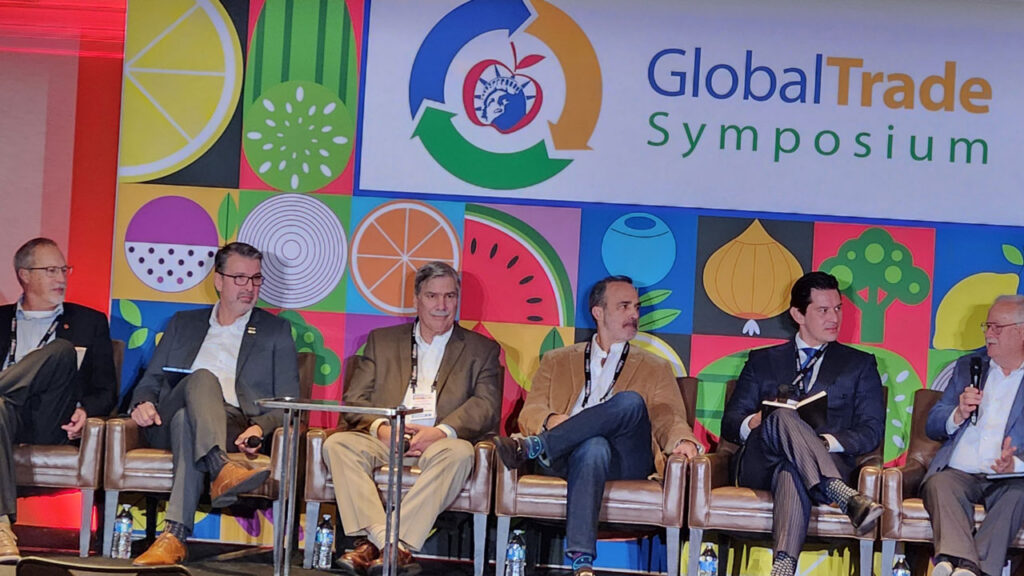
The panel focused on the impacts of tariffs. Capote notes that at J&C Tropicals, the priority is ensuring tariffs do not interfere with business, emphasizing that “the two most important things to us are consumers and growers.”
Lemaire urges a broader view of tariff impacts, pointing out that duties on Chinese materials affect multiple parts of the supply chain, including packaging. He added that Canadians felt the impact of the 10% tariff on U.S. goods, emphasizing consumer sentiment: one-third of Canadians now say they avoid U.S. products. “We can’t forget the consumer impact in Canada,” he says, noting the need to rebuild trust. “We need each other — Canada needs the U.S., and the U.S. needs Canada.”
Morales highlighted Mexico’s global position, noting the country holds a 26% surplus. He warned that U.S. prices could rise by 30%, while Mexican production may fall by 12%. “We are really concerned about the industry and what will happen in the next few months,” he says.
Pandol compared tariffs to any other cost added to the system, while Zeutenhorst raised concerns about labor instability. He explained that in 2023, 99% of returns on Washington apples went to labor and criticized the inconsistency of the H-2A program. “This inconsistency is my concern in the upcoming negotiations.”
Capote closed with a strategic perspective: stronger companies will adapt and rise to the moment, but “my biggest worry is the losers we’ll start seeing coming down the pike.”
NAVIGATING TURBULENCE IN TRANSPORTATION & LOGISTICS
Maintaining the cold chain and ensuring timely deliveries of fresh produce has become increasingly difficult. Labor shortages, tariffs, smaller harvests, extreme weather and shifting trade routes are forcing importers to adapt quickly. This session explored the strategies companies are using — and planning — to strengthen supply chain resilience.
Panelists included Florent Philippot, ZGroup USA LLC; Jai Thakrar, chief executive, Jalaram Fruit; Mike Laws, president, Laws Logistics; and Tony Martinez, managing member, Primo Trading Services. Anthony Serafino, chief executive, EXP Group, moderator the panel.
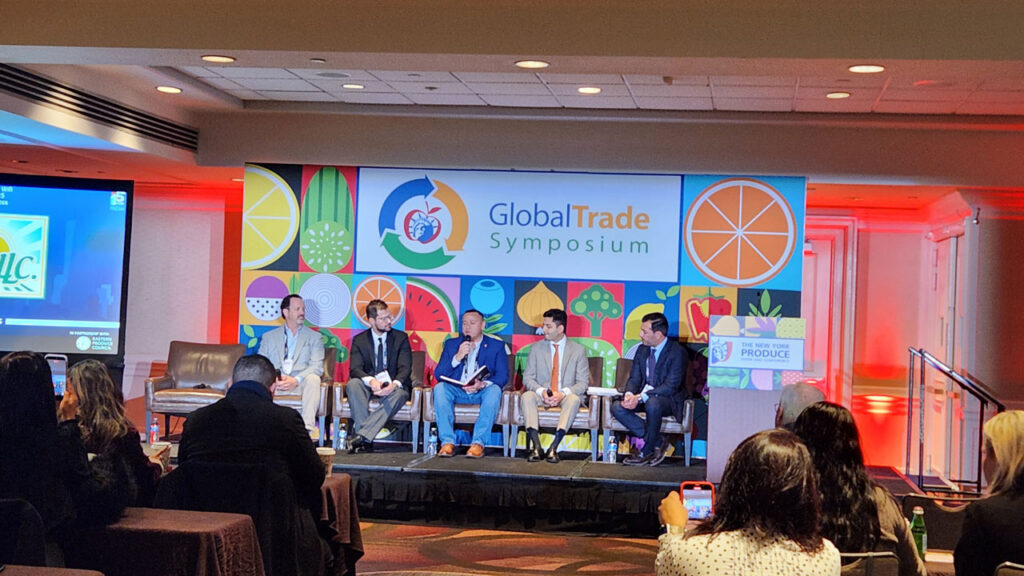
Martinez emphasized the ongoing challenges at the border, noting, “We need to tackle and address every border issue.”
Thakrar pointed to significant congestion at South American ports, explaining that demand is outpacing port capacity: “The ports can’t keep up.” Serafino added that U.S. port technology lags behind that of other countries.
Thakrar highlighted that waiting a full week for inspections at the Los Angeles port is unsustainable and that major infrastructure improvements are urgently needed. Martinez says their company monitors every port closely to understand the shifts in consumer demand, noting McAllen and Pharr, TX, as the top-performing U.S. ports at the moment.
“Collaboration is everything, and we are behind as an industry,” says Serafino, with Philippot agreeing, “We need to work together to make that happen.”
Regarding automation, Thakrar cautioned that technology alone won’t solve the most pressing issues. “There are some parts where automation will help, but ports need much more than automation. There are fundamental issues that must be addressed first.”
He also noted a shift in consumer expectations: “For the past 20 years, the focus was just keeping product on the shelf. Today, consumers want more — and logistics play a critical role.”
SEEDS OF CHANGE
In the Seeds of Change session, panelists discussed the creativity, characteristics and new variety development of seeds, from ideation to marketing, and ultimately, positioning in stores.
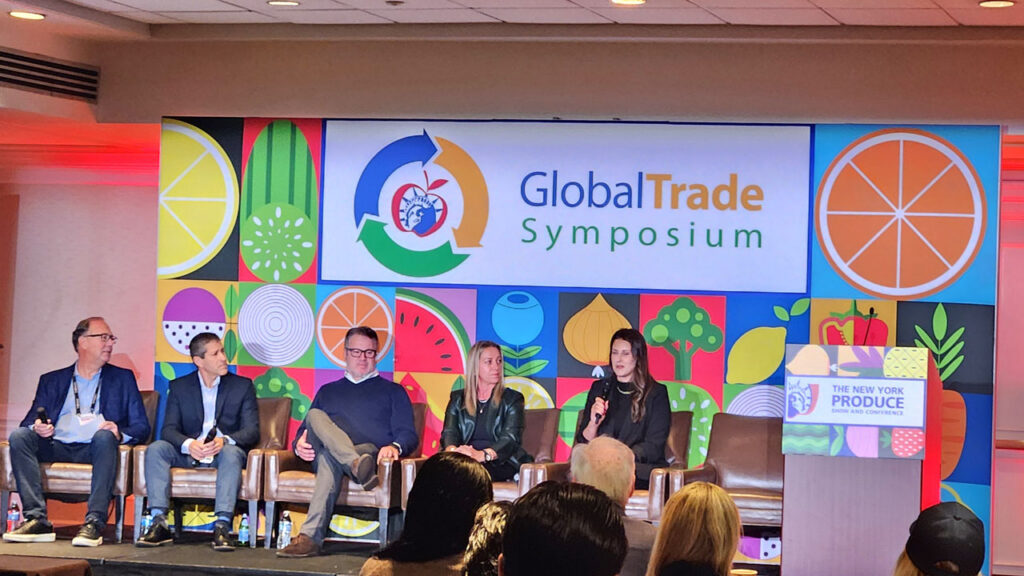
Panelists included Amanda Knauff, vice president of NE sales, Taylor Farms; Ernst van Eeghen, vice president of business development, Church Brothers; Jenny Maloney, strategic accounts manager, Bayer Crop Science; and Uri Krieger, global head of R&D, vegetable seeds and flowers, Syngenta. Craig Carlson, chief executive, Carlson Produce Consulting, was the moderator.
Krieger notes that the real complexity lies in the food chain itself, with each segment approaching sustainability in its own way. He warned that new pathogens are emerging at unprecedented rates.
Van Eeghen emphasized that the industry’s focus must remain on yield and quality. “We’re not adding acreage,” he says. “Disease pressure and environmental stress are rising. Plant diseases are increasing. We need to work with breeders to strengthen genetics as much as possible.” He added that growers are often forced to “roll the dice.”
Knauff pointed to labor as a major concern, using iceberg lettuce as an example. Her team asked whether there was a better way to handle it. “You have to think about the future,” she says. “We have automation, but in some cases the process hasn’t caught up yet.”
Maloney stressed the need for industrywide collaboration, and Knauff agreed, highlighting the value of consumer insights. “We want people to come to fresh first.”
Krieger added that breeders typically see new varieties for only three to four years before they reach the market — nowhere near enough time to optimize for flavor and quality. Consumers, he says, expect watermelon in the winter to taste as it does in the summer, “but we will never get that.”
Knauff observed that today’s consumers are hungry for flavor and innovation. “People want something new, so we have to push boundaries. Every dollar matters, so you’d better make it worth it.”
Maloney echoed that the industry must invest more in understanding consumers. She cited broccoli chips made from long-stem broccoli as an example of how asking growers to take risks can help new products reach the market.
Van Eeghen underscored the importance of cross-collaboration. “Be curious, ask questions, engage.” Krieger closed with an example from melons, noting that Syngenta advises against harvesting melons while they’re still green — guidance that, if followed, could help increase overall consumption.
The one-day trade show and three co-located events are Dec. 2-4. The New York Produce Show is organized by Produce Business and the Eastern Produce Council.
Have a story to share?
Take a place at Produce Business